Pages

.

Showing posts with label #Organic. Show all posts

Conventional Produce Is Not Dirty, But The Marketing Tactics Of Big Organic Are

Spinach - a crop that is getting a bum rap (picture by Victor M. Vicente Selvas)


(This post originally appeared on Forbes on 3/13/17)

For each of the last twenty years, an organization called the Environmental Working Group has issued what it calls a “Dirty Dozen List.” It names crops it claims to have high pesticide residues and recommends that consumers purchase organic versions of these crops. They base their list on a seriously distorted interpretation of a taxpayer-funded testing program called the PDP (Pesticide Data Program, USDA). What the PDP actually documents is that our food supply is extremely safe. EWG has repeatedly been called out for promoting this science-free list and for the counter-productive effect it is having on produce consumption by Americans. Yet, EWG persists in employing this strategy as a means of fund raising. Presumably it also serves the interests of their corporate funders in the organic food industry (see list below).  Note that these are very large, processed food players with only one produce company in the list.


The real "dirty dozen"

In its latest campaign, EWG is singling out a few crops for added demonization – notably spinach. They highlight certain specific chemicals that were detected in spinach samples by the USDA in 2015. I have looked in detail at this same, publicly available data. It turns out that 7% of the 2015 spinach samples were organic. The very same chemicals that EWG choses to talk about were found on those organic samples. As with virtually all of the residues found on all crops, the quantities that the USDA analytical chemists found were at very low levels - well below any possible level for health concern. Still, it is ironic that the same flawed logic that EWG uses to scare consumers away from perfectly safe conventional spinach says that they should also avoid the organic alternative.


Bagged Baby Spinach (CCO Public Domain)


Experts agree that one of the best things we can do for our health is to consume a lot of fruits and vegetables (here is one example of why that makes sense). Sadly, all too few Americans do that. Spinach is one of the more popular vegetables that can help move consumers in the right direction, particularly since it has become available as a convenient fresh, pre-washed option. Discouraging consumption of any kind of spinach is a notably irresponsible thing to do, particularly through disinformation. An industry group that represents both conventional and organic produce companies (and many are both) offers an on-line calculator using the USDA’s data and legitimate toxicological information. With this tool consumers can visualize just how safe products like spinach actually are. For instance, a child could safely eat up to 310 servings of spinach a day without negative effects from the trace chemicals on that crop.

Aphids on spinach (Image by demintedmint)
As I wrote last week, organic and conventional produce are actually quite similar when it comes to the presence of low levels of pesticide residues. Because EWG singled out spinach in its recent fund raising email campaign I thought it would be worthwhile to get into the details for that crop.

For instance, EWG focuses on the synthetic pyrethroid insecticide, permethrin, which it calls a “Neurotoxic bug killer.” That sounds scary, but pyrethroids all have the same mode of action as the natural product called pyrethrin derived from Chrysanthemums (pyrethrin is used on organic crops).  As a class the pyrethroids are only slightly toxic to mammals and are considered safe enough to be in many household, garden and pet products sold to consumers.  One of the synthetic versions, Permethrin, is among the most used crop protection agents on spinach to prevent damage from caterpillar pests and infestations with aphids. These are not things we would like to find in our salads!

The USDA detected an average of 0.8 parts per million of permethrin on the 2015 conventional spinach samples. That is only 4.2% of the conservative tolerance set by the EPA, meaning it isn’t even close to something to worry about. On the organic samples from the same season, the USDA detected an average of 0.9 parts per million permethrin– essentially the same level as with conventional.

EWG also calls out the fact that traces of DDT and its metabolites were found in some spinach samples. These are unfortunate, long-term soil contaminants still slowly decomposing decades after that old product was banned. Their presence is certainly not related to whether the current spinach crop is grown conventionally or under the organic rules. Fortunately, the levels are tiny – seven parts per billion for the conventional and 11 parts per billion for the organic. These are only 1-2% of the level that the EPA considers to be of concern.

Permethrin and DDT are the products detected on spinach that the EWG chose to talk about. There were residues of 30 other synthetic pesticides on the organic spinach in 2015. The USDA does not test for at least two dozen other organic-approved pesticides that are used on spinach (biocontrol agents, mineral compounds, natural product chemicals). None of this means that organic spinach is “dirty.” Conventional spinach isn’t “dirty” either. What is “dirty” is the tactic is telling consumers they need to buy organic because of residue concerns without acknowledging that the organic products have similar, low-level residues.
In my opinion the "Dirty Dozen" should refer to the eleven big-organic companies that support the EWG and the EWG itself.

You are welcome to comment here and/or to email me at savage.sd@gmail.com


reade more... Résuméabuiyad

Organic Might Not Mean What You Think It Means

(This post originally appeared on Forbes 3/6/17)

Organic might not mean what you think it means.  Recent data generated as part of the USDA’s Pesticide Data Program (PDP) shows that there are detectable, low level pesticide residues on organic fruits and vegetables. This isn't surprising information.  It echoes results from previous PDP testing and with more comprehensive testing of organic samples in 2001-11 by the USDA and 2011-13 by the Canadian Food Inspection Agency. What is interesting is that while the incidence of residue detection is somewhat lower for organic, the very low levels of chemicals found are quite similar to the low levels detected on conventional samples. The 2015 PDP study found residues of 68 different pesticides, pesticide metabolites, or plant growth regulators on organic fruits and vegetables.


Red organophosphates, Blue carbamates, Green organochlorines from historical use


For 37% of these chemicals the average residue on organic samples was actually higher than the averages on conventional, but still very small.
What really matters is that the levels detected for both kinds of produce are below the “tolerances” that are set by the EPA and those tolerances already reflect a generous safety margin.  

So, what these data really tell us is this:
“Yes. Skilled analytical chemists can detect tiny amounts of synthetic and natural pesticide residues on organic and conventional produce. In both cases the level that are found are below to well below any threshold of concern. Our regulatory system is working. Those who grow our food are well trained and are following the rules designed to both enable crop production and protect the public. Enjoy your safe, healthy, delicious options!”

Background on the PDP


Each year the USDA gathers and analyzes around ten thousand samples from the mainstream US food supply – mainly fruits and vegetables. In the sampling process, USDA ends up including some items labeled as USDA Organic (349 samples in 2015, 4% of the total). USDA labs then look at all the samples for residues of crop protection chemicals using extremely sensitive analytical methods.

USDA provides both brief and detailed summaries of this information, but I appreciate the fact that the raw data is transparently available to the public so that I can look through it myself (it is bit challenging because there is a two million+ row main table, a 10 thousand row sample table, and 18 reference tables). I looked in detail at all the pesticide detections and also looked at the testing results for produce samples that were being sold with the organic claim.

What Was Found?


As with the overwhelming majority of samples, the residues detected on the organic items are at levels below the conservative “tolerances” that are set by the EPA. Yes, residues are present. No, they are not a safety problem. However, the presence of residues does conflict with what many consumers have been led to believe about the difference between organic and conventional.

Many people think that organic means “no pesticides.” That is simply not true. Organic farmers can and do use a range of allowed pesticides because they too have to deal with pests. The list of organic-approved pesticides is not based on safety criteria but rather on whether or not they can be considered “natural.” Again, in spite of much misleading marketing, “natural” does not automatically mean safe. In fact the USDA which is in charge of organic certification specifically states on its website that “our regulations do not address food safety or nutrition.”

As with all pesticides and other crop protection products, it is the EPA which assesses which pesticides can be used safely, and within what constraints.

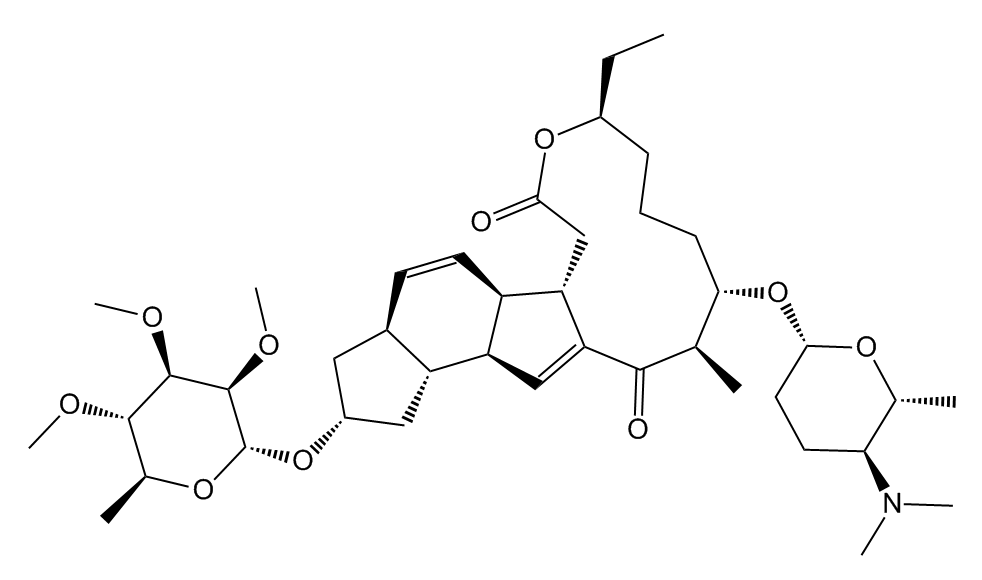
So what sorts of residues are found on the organic samples? The most common detection is of an insecticide called spinosad. That is an effective control for a variety of caterpillar pests and is produced through a microbial fermentation process, thus allowing it to qualify for use in organic (see chemical structure of one of the spinosyns below). Just to be clear, the spinosad products are produced by the Dow chemical company.

Chemical structure of a spinosan (Image from Cappacio)
Conventional farmers also make good use of this and other natural products. Spinosad is really the only natural product pesticide that is detected in the USDA’s monitoring program. Other widely used products like sulfur, petroleum distillates, copper salts and microbial products can’t be monitored using the same, highly sensitive and cost-effective tools that allow the USDA to generate the more than two million test results they generate each year. If specific tests were conducted for those natural products, the number of residues detected per organic sample would probably be much larger – but it wouldn’t really change the overall conclusion that these foods are safe to enjoy.


Other than spinosad, the remaining 80.2% of residues detected on organic are of “synthetic” chemicals.

Graph by author

While very few of the synthetic materials used in agriculture today are intrinsically very toxic to humans, they are theoretically not supposed to be present on organic because they are not on the list of approved, natural options.

There is however a rule in the organic certification system that any residue present at 5% or less of the USDA tolerance will be considered “unintentional” and thus not a reason to deny organic certification. 62.1% of the 2015 organic detections met that criterion, but interestingly so do 74.6% of the detections on non-organic samples from the US and 70.1% of the detections from imported, non-organic samples. Not so different.

Another 15.6% of residues detected on organic technically violate the organic rules by being over 5% of EPA tolerance, but such residues are still fully safe based on EPA criteria. That same safety criterion applied to 23.0% and 25.2% of conventional US and imported samples respectively. For both organic and conventional there are a few detected residues of products that don’t have a specific, assigned tolerance for the crop in question. These are generally very low-level detections, so while they represent technical violations they are not of real concern and once again, similar for organic and conventional (average “no tolerance” detection for organic 23.7 parts/billion, average for conventional imports 19.8 ppb, and average for US conventional 17.2 ppb).

To reiterate, what this transparent public database tells us is that our food supply is safe from the perspective of pesticide residues. This means that our regulatory system is working and that thousands of farmers in the US and elsewhere are doing a great job of managing pest damage while still protecting our health. The data also tells us that there are some striking similarities between organic and conventional when it comes to residues. What the data also tells us is that as consumers we should reject some of the misleading marketing and advocacy efforts of certain irresponsible elements of the organic industry. Instead of giving in to those fear-based campaigns we should feel the freedom to choose healthy and delicious produce using important criteria like freshness, flavor, quality and affordability.

There is a site you can use to visualize the PDP data http://www.cropaudit.org/

You are welcome to comment here and/or to email me at savage.sd@gmail.com


reade more... Résuméabuiyad

Vermont-Driven GMO Labeling Could Have Troubling Unintended Consequences

This small state may soon alter the food supply for all Americans

(This post originally appeared on Forbes on 3/26/16)

Over the past week and a half, Mars, General Mills, ConAgra Foods and Kellogg announced that they had decided to start labeling whether their products contain GMOs nationwide, in compliance with a pending Vermont statute. They see this as a way to avoid the cost of maintaining multiple systems for different states.


These companies clearly state that they agree with the scientific consensus that there are no safety issues with biotechnology as it has been applied to crops. Nonetheless, many observers believe that the ultimate impact of the Vermont labeling law will be to encourage companies to seek to use more non-GMO ingredients. That would, of course, be a major victory for the organizations that have promoted labeling and who are actually quite transparent about their agenda of eliminating use of the technology all together.

However this scenario plays out, there are three interesting questions to consider.
  1. Why do so many consumers say they want GMO labeling?
  2. Why was anyone against labeling in the first place?
  3. What might be the long-term effects of this labeling requirement on our food supply?

Why do so many consumers say they want GMO labeling?


This has much to do with how you ask the question.  The term "GMO" is a misleading title made up by anti-GMO activists in Europe in the mid 1990s.  It stands for "Genetically Modified Organism," which isn't a very good term to use since virtually every crop and animal used for food today has had its genetics dramatically modified from what ever it once was in the wild.  However, since few consumers realize this, the term "GMO" has the negative emotive effect that was intended.

The genetic modifications of these plants were vastly 
more dramatic than any modern “GMO crop”

If you use emotive language to ask people about other scary-sounding foods, you can get the same reaction. I've asked many people, "do you think cloned fruit should be labeled?" Virtually everyone says "yes!" Then I explain that all fruit is "cloned" in the sense that it is vegetatively propagated by budding or from cuttings because if you grew it from seed you wouldn't get the same variety. People have been doing this for millennia, but if I use the emotive term "cloned" I can get a "label it" response.

I also sometimes ask, "do you think that food grown with products made from animal excrement should be labeled?"  Most people again say "yes" because I used an emotive term. In that case there is a small, but finite food safety risk associated with manures and composts, but we don't label it.

In any case, after 20 years of active efforts to create fear around plant biotechnology, the label is nearly guaranteed to be seen as a negative by many consumers. Again, that is exactly what certain parties hope.

Why was anyone against labeling in the first place?

On the surface this seems like a logical question, but there were rational reasons to oppose these labels. The FDA wants to reserve the exercise of its labeling authority for things with real, documented risk issues such as food allergies, not for something like biotech crops for which extensive studies show no unique risk.  Realistically, this has become a moot point. By allowing "non-GMO" and "GMO-free" labels, consumers are already being successfully recruited to buy this next example of "non-existence" food, following trends like "gluten-free," "fat-free," "zero cholesterol" and the like.  American consumers are so used to buying food for what it is not that we don't even see the absurdity.


Much of the non-GMO labeling is for products
from crops which have no commercial biotech versions anyway


The reason that the processed food industry opposed labeling for biotech crops has to do with the costs and liabilities associated with maintaining distinct product flows in these very large scale, very low profit margin businesses. It costs money to clean out all the equipment, bins, trains and trucks used for bulk handling.
Grain harvesting equipment and later handling 
are not conducive to easy segregation

Depending on tolerances, it also opens companies up to liabilities for "adventitious presence.”  In the absence of real risk, the costs just don’t make sense. “Identity preservation” of high value crops like apples, oranges or wine grapes is far more feasible, and it is routinely done, but for issues that matter like variety, appellation etc.

What might be long-term effects of labeling on the food supply?

This really depends on whether food companies have the courage to trust their customers enough to continue to use biotech-improved items even in the face of activist pressure. Will they stand-up for their decision (as the Girl Scouts have), or will they give in and start shifting to non-GMO ingredients?

Evidence suggest that many players will take the latter path and that will mean asking farmers to forgo crop traits that they have found to be very helpful. Returning to non-biotech will also make it harder for farmers to use environmentally-sound approaches like minimum-tillage. It will increase the need to spray for insect pests once controlled by Bt traits in the crops. The cost of those non-GMO ingredients will be higher, partly because of these disadvantages, but also because of what it will take to "identity preserve" the non-GMO harvest all the way down the handling, storage and processing stream.

Of greater concern is the possibility that food companies will be tempted to source cheaper version of these non-GMO ingredients from other countries. This has happened all too often for organic.  That will open up the U.S. consumer to environmental pollutants (e.g. heavy metals) and to pesticides that have long been banned here, but which are still made and used in places like China and India.  It will also mean getting items from regions that are much less attuned to the need to detect and exclude dangerous mycotoxins from the food supply.

If Vermont ends up initiating a trend towards more non-GMO products, we should be asking participating food companies to go on record promising that they won't import the ingredients if they are available from the U.S. or other countries that enjoy a general context of sound environmental, food safety, and pesticide regulation. Without such assurances, we could have a serious case of unintended consequences.

You are welcome to comment here and/or to email me at savage.sd@gmail.com
reade more... Résuméabuiyad

Why I Don't Buy Organic, And Why You Might Not Want To As Well

Some delicious, conventional Asian Pears

Originally Posted On Forbes 3/19
I don’t buy organic foods. In fact I specifically avoid doing so. It’s not my place to tell anyone else what to do, but I’d like to lay out three, seriously considered factors that have shaped my personal stance on organic:

  1. Informed confidence that we are safe buying “conventional” foods
  2. Recognizing that some of the best farming practices from an environmental perspective are not always allowed or practical under the organic rules
  3. An ethical problem with the tactics that some organic advocates and marketers employ which seriously misrepresents their “conventional” competition
For the last 40 years my wife and I have shared the shopping and cooking for our mostly home-based meals. We have always gardened, but also buy much of our fruit- and vegetable-rich diet from stores. When I say I don’t buy organic, that involves frequent decisions.

By all rights I should be an enthusiastic advocate and consumer of organic. I was a child of the generation influenced by “Silent Spring.” I was a dues-paying member of the Wilderness Society in high school. I grew up helping my beloved grandfather in his organic garden in the 1960s.  Some of our best friends in the late 1970s were pioneers in the development of the commercial organic industry. I’ve spent a significant proportion of my career developing biological and natural product-based pesticides which are applicable to organic. I fully appreciate the contribution that the organic movement made in the early 20th century when it highlighted the importance of fostering soil health. My problems with institutional organic are not at all about its founding ideals or about organic farmers, but rather about organic's self-imposed limitations and about the ethics of a sub-set of its promoters.

Confidence in the Conventional Food Supply
The USDA, which oversees the foods labeled as "Certified Organic", states quite clearly on its website about its role in organic,  that "Our regulations do not address food safety or nutrition."  Foods labelled "Certified Organic" must adhere to certain rules and regulations but aren't endowed with any particular nutritional or safety features. However, many consumers believe that the Organic label means the food has superior nutrition and is safer, especially in regard topesticide residues.  This is not true. Studies have shown no appreciable difference in nutrition between crops grown either organically or conventionally.

As for the safety issue. When most people hear the word “pesticide,” they imagine something scary in terms of toxicity to humans and the environment. The reality is that modern agriculture employs an integrated suite of non-pesticidal control measures, and the actual pesticides used today are mostly relatively non-toxic to humans. Organic farmers also use pesticides, and the products they are allowed to use are constrained with few exceptions by whether they can be considered “natural.” That is not a safety standard since many of the most toxic chemicals known are “natural.” Like all pesticides, these natural options are subject to EPA scrutiny, and so the pesticides that organic farmers are allowed to use are “safe when used according to the label requirements” which is the same standard for synthetic pesticides allowed on conventional crops. When it comes to pesticide residues on our food, there is a USDA testing program that demonstrates year after year that the pesticide residues on both organic and conventional foods are at such low levels that we need not worry about them. I confidently buy non-organic foods based on this public data that demonstrates that our system is working and that we consumers are well-protected.
My granddaughter enjoying "conventional" raspberries (yes, she did then eat them)


What the USDA data demonstrates is that the environmental movement was not a failure - it effected real change over the past 5 decades! We don’t have a two-tiered food supply in terms of safety in which only those who can afford the premiums get safe food. I also believe the global scientific consensus that“GMO” foods are safe, and so I don’t need to buy organic to avoid those.
This No-Till Field is good for the environment and the food supply 
Environmental Idealism

I have always been concerned about the human impact on the environment, and particularly about the impact of farming since that industry has the largest “footprint” in terms of land area. I spend a lot of time reading the scientific literature concerning agriculture and the environment. Some of the farming practices that are commonly employed on organic farms are very positive from an environmental perspective, but those practices are also used by progressive “conventional” growers. There are also quite a few farming practices with excellent environmental profiles which are difficult to implement under the organic farming rules (e.g. no-till farming,spoon-feeding of nutrients via irrigation). Compost, which is a major input for organic farms, has a shockingly high “carbon footprint” because of methane emissions. The carbon footprint of “synthetic” fertilizer is much smaller.
From an environmental perspective, the biggest issue for organic is that it requires significantly more land to achieve the same level of production. Were organic to become more than a niche category, this yield gap would be highly problematic from an environmental point of view.  I would much rather buy food from "land-sparing" farmingsystems.

Organic yields are substantially lower for many major crops


Ethical Issues

My third reason for not buying organic has to do with ethics. Organic exists as a sort of “super brand” that transcends anyone marketing under that banner. Unfortunately, within the organic realm there are certain major marketers (and advocacy groups they fund) who employ fear-based and falsehood-based messages to demonize “conventional” foods.  They use these methods as a means to promote organic. One of the most egregious examples is the “Old McDonald/New McDonald” video funded by Only Organic – a consortium of very large organic marketers. This bizarre publicity piece exploits children to depict a completely distorted view of mainstream farming.  I consider it to be "hate speech for profit."

Another example is the organic-industry-funded Environmental Working Group which grossly distorts that transparent, USDA, public database documenting the safety of the food supply and turns it into a “dirty dozen list” designed to drive organic sales. These are extreme examples, but the organic marketing community as a whole quietly benefits from this sort of propaganda and does nothing to correct the “convenient fiction” that organic means no pesticides. I realize that only part of the organic industry funds and promotes the most vicious sort of disinformation, but I rarely see organic representatives standing up and objecting to the sort of fear-mongering that ultimately benefits the sales for the entire super-brand.

The fear-based messaging drives the intense social pressure, that parents in particular feel, about whether they need to buy organic. I don’t want any part in rewarding this sort of fear/shame-based marketing. In the absence of a significant objection from more of the organic community, I don't want to support the "super brand."


So, these are my reasons for not buying organic products. I feel perfectly comfortable buying the alternatives that align with my practical, idealistic and ethical standards.

Please feel free to comment here and/or to email me at savage.sd@gmail.com

reade more... Résuméabuiyad