Pages

.

Showing posts with label no-till. Show all posts

Why Wheat Is Like Wine

image002
Wheat harvest on the Palouse in Idaho
(This post was originally on the Better Food Stories blog 9/26/16)

There is a term in the wine grape industry called “terrior” which celebrates the fact that fruit quality for wine making is greatly influenced by cultivar, climate and soil type.  Year-to-year differences in weather further influence the quality of specific “vintages.”  Wheat may be a humbler crop, but it is like wine in the sense that there are different classes of wheat for different end-use products and there are different regions where each type excels based on climate (wheat can be hard or soft, spring or winter, red or white, and there is a separate type called “durum” for pasta).  There are even year-to-year differences in quality.  For instance, to make an artisan bread, it is best to use flour from hard red spring wheat, that comes from the northern plains (North Dakota, Minnesota) or from the prairie provinces of Canada (e.g. Alberta and Saskatchewan).  For Asian noodles one wants a soft white winter wheat from the Pacific Northwest.  For crackers a soft red winter wheat is best from a place like Southern Illinois or Kentucky.  For pasta, a distinct type of wheat called durum is used and this is grown in Arizona and in the northern plains.

There are several important measures of wheat quality that reflect important properties of the dough, like strength and elasticity. These properties drive features, like how well the dough will rise and balance of different classes of starch, which influence the texture of baked products.  A yearly report on U.S. hard red spring wheat examines eight categories of “grading” data and eleven measure of “kernel quality.”  53% of U.S. wheat and 60% of Canadian wheat are exported around the world and purchased by customers looking for specific qualities (based on FAOStats data 2011-13). Europe is a major producer of wheat and has much higher wheat yields compared to the lower rainfall production areas in North America, but European countries still import a great deal of wheat for high quality bread and pasta and use much of their domestic production for animal feed.

As with all crops, wheat is attacked by various pests. Unlike grapes, it is possible to deal with some of the pests by breeding resistant varieties of wheat (winemakers are reluctant to accept new grape varieties preferring the traditional favorites that have been in use for hundreds of years).  A key advance in the “Green Revolution” of the 1960s was developing resistance to a particularly damaging fungal disease called “Stem Rust.”  That resistance held up for decades, but in 1999 a strain of the fungus overcame the trait, and since then wheat breeders worldwide have worked to breed a new resistance gene into all the different genetic backgrounds for the diverse wheats grown around the world.

In wet climates, wheat can be infected by many different fungal pathogens and commercial production requires the use of several protective fungicide treatments, starting with seed treatments and spaced throughout the growing season.  In drier North America, diseases are not as problematic, but do sometimes require treatments to preserve yield and quality.  If it rains during the time when the wheat is flowering, a fungus called Fusarium can infect the crop and wheat has proven to be very difficult to breed for resistance. A well timed fungicide spray can help against this disease, but that is not always possible. This particular fungus can produce a mycotoxin chemical in infected wheat kernels called Deoxynivalenol or DON.  It is also called “vomitoxin” because of the effect it has on animals that consume contaminated grain. In our food system, the consumer is well protected from exposure to such toxins, thanks to the care and expense taken on by farmers.
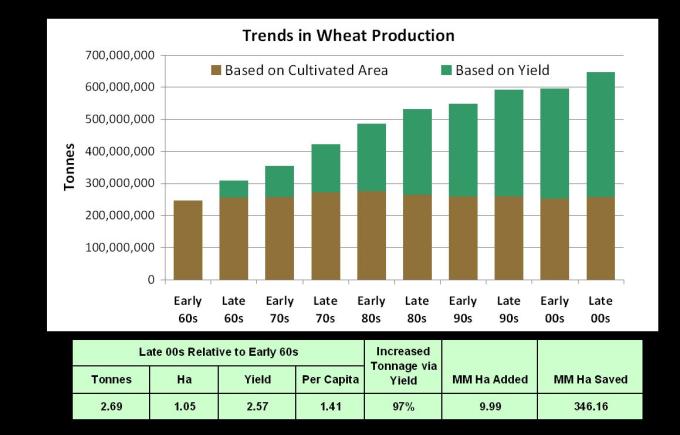
The global wheat industry is really made up of many distinct sub-crops, but as a whole, wheat production has been making steady progress in keeping up with growing global demand with only minimal expansion in planted areas (see graph below).  Some of that progress has been made by diminishing pest damage through a combination of breeding and crop protection agents like fungicides.  Also, a great deal of modern wheat production is in “no-till” systems where weeds are controlled with herbicides instead of by mechanical tillage.  This system greatly reduces soil erosion, lowers fuel use and leads to improved soil health and carbon sequestration.
image003
The green part of each par shows the proportion of the increased production achieved through higher yield rather than additional planting area
So the next time that you enjoy a wheat-based product, think about the effort and risk that a wheat farmer faced, not only to produce the grain, but to produce it with the positive qualities needed and with the absence of issues like DON toxin.

reade more... Résuméabuiyad

Why I Don't Buy Organic, And Why You Might Not Want To As Well

Some delicious, conventional Asian Pears

Originally Posted On Forbes 3/19
I don’t buy organic foods. In fact I specifically avoid doing so. It’s not my place to tell anyone else what to do, but I’d like to lay out three, seriously considered factors that have shaped my personal stance on organic:

  1. Informed confidence that we are safe buying “conventional” foods
  2. Recognizing that some of the best farming practices from an environmental perspective are not always allowed or practical under the organic rules
  3. An ethical problem with the tactics that some organic advocates and marketers employ which seriously misrepresents their “conventional” competition
For the last 40 years my wife and I have shared the shopping and cooking for our mostly home-based meals. We have always gardened, but also buy much of our fruit- and vegetable-rich diet from stores. When I say I don’t buy organic, that involves frequent decisions.

By all rights I should be an enthusiastic advocate and consumer of organic. I was a child of the generation influenced by “Silent Spring.” I was a dues-paying member of the Wilderness Society in high school. I grew up helping my beloved grandfather in his organic garden in the 1960s.  Some of our best friends in the late 1970s were pioneers in the development of the commercial organic industry. I’ve spent a significant proportion of my career developing biological and natural product-based pesticides which are applicable to organic. I fully appreciate the contribution that the organic movement made in the early 20th century when it highlighted the importance of fostering soil health. My problems with institutional organic are not at all about its founding ideals or about organic farmers, but rather about organic's self-imposed limitations and about the ethics of a sub-set of its promoters.

Confidence in the Conventional Food Supply
The USDA, which oversees the foods labeled as "Certified Organic", states quite clearly on its website about its role in organic,  that "Our regulations do not address food safety or nutrition."  Foods labelled "Certified Organic" must adhere to certain rules and regulations but aren't endowed with any particular nutritional or safety features. However, many consumers believe that the Organic label means the food has superior nutrition and is safer, especially in regard topesticide residues.  This is not true. Studies have shown no appreciable difference in nutrition between crops grown either organically or conventionally.

As for the safety issue. When most people hear the word “pesticide,” they imagine something scary in terms of toxicity to humans and the environment. The reality is that modern agriculture employs an integrated suite of non-pesticidal control measures, and the actual pesticides used today are mostly relatively non-toxic to humans. Organic farmers also use pesticides, and the products they are allowed to use are constrained with few exceptions by whether they can be considered “natural.” That is not a safety standard since many of the most toxic chemicals known are “natural.” Like all pesticides, these natural options are subject to EPA scrutiny, and so the pesticides that organic farmers are allowed to use are “safe when used according to the label requirements” which is the same standard for synthetic pesticides allowed on conventional crops. When it comes to pesticide residues on our food, there is a USDA testing program that demonstrates year after year that the pesticide residues on both organic and conventional foods are at such low levels that we need not worry about them. I confidently buy non-organic foods based on this public data that demonstrates that our system is working and that we consumers are well-protected.
My granddaughter enjoying "conventional" raspberries (yes, she did then eat them)


What the USDA data demonstrates is that the environmental movement was not a failure - it effected real change over the past 5 decades! We don’t have a two-tiered food supply in terms of safety in which only those who can afford the premiums get safe food. I also believe the global scientific consensus that“GMO” foods are safe, and so I don’t need to buy organic to avoid those.
This No-Till Field is good for the environment and the food supply 
Environmental Idealism

I have always been concerned about the human impact on the environment, and particularly about the impact of farming since that industry has the largest “footprint” in terms of land area. I spend a lot of time reading the scientific literature concerning agriculture and the environment. Some of the farming practices that are commonly employed on organic farms are very positive from an environmental perspective, but those practices are also used by progressive “conventional” growers. There are also quite a few farming practices with excellent environmental profiles which are difficult to implement under the organic farming rules (e.g. no-till farming,spoon-feeding of nutrients via irrigation). Compost, which is a major input for organic farms, has a shockingly high “carbon footprint” because of methane emissions. The carbon footprint of “synthetic” fertilizer is much smaller.
From an environmental perspective, the biggest issue for organic is that it requires significantly more land to achieve the same level of production. Were organic to become more than a niche category, this yield gap would be highly problematic from an environmental point of view.  I would much rather buy food from "land-sparing" farmingsystems.

Organic yields are substantially lower for many major crops


Ethical Issues

My third reason for not buying organic has to do with ethics. Organic exists as a sort of “super brand” that transcends anyone marketing under that banner. Unfortunately, within the organic realm there are certain major marketers (and advocacy groups they fund) who employ fear-based and falsehood-based messages to demonize “conventional” foods.  They use these methods as a means to promote organic. One of the most egregious examples is the “Old McDonald/New McDonald” video funded by Only Organic – a consortium of very large organic marketers. This bizarre publicity piece exploits children to depict a completely distorted view of mainstream farming.  I consider it to be "hate speech for profit."

Another example is the organic-industry-funded Environmental Working Group which grossly distorts that transparent, USDA, public database documenting the safety of the food supply and turns it into a “dirty dozen list” designed to drive organic sales. These are extreme examples, but the organic marketing community as a whole quietly benefits from this sort of propaganda and does nothing to correct the “convenient fiction” that organic means no pesticides. I realize that only part of the organic industry funds and promotes the most vicious sort of disinformation, but I rarely see organic representatives standing up and objecting to the sort of fear-mongering that ultimately benefits the sales for the entire super-brand.

The fear-based messaging drives the intense social pressure, that parents in particular feel, about whether they need to buy organic. I don’t want any part in rewarding this sort of fear/shame-based marketing. In the absence of a significant objection from more of the organic community, I don't want to support the "super brand."


So, these are my reasons for not buying organic products. I feel perfectly comfortable buying the alternatives that align with my practical, idealistic and ethical standards.

Please feel free to comment here and/or to email me at savage.sd@gmail.com

reade more... Résuméabuiyad

Why Organic Can't Fulfill Our Food Supply Ideals


Almost any farmer or consumer could agree on the following ideals for our agricultural system:

"Farming in ways that are best for us, best for the environment, and best for providing an adequate food supply."

I believe that these are the goals and ideals of organic customers and organic farmers, and I share them. If organic could deliver on these “triple best” goals, I would be among its strongest supporters, but I don't believe that it can.  The organic rules are based on the assumption that “natural” is always best.  That assumption originated in a pre-scientific era, and it does not hold up to what we have learned over the last century.  The "natural" definition is great for marketing purposes, but often not the optimal criterion to guide farming practices. 

The Original Contribution of the Organic Movement


The important contribution of organic early in the last century was its focus on improving soil health/quality.  The pioneers of the organic movement worked out certain farming methods using “natural fertilizers” to mitigate the nutrient-depleting and soil-degrading effects of the plow-intensive farming of the late 19th and early 20th century.  The organic focus on natural also meant that it eschewed some of the early pesticides, which were later found to be problematic for health and the environment.  For a period of time, organic may have been, in fact, the best farming option for us and for the environment.

A pretty picture, but for soil erosion and soil health this
kind of farming was highly undesirable


Since then we have learned more and more about environmental systems, genetics, microbiology and human health.  Based on that, increasingly rigorous regulatory processes were put in place and farming practices have changed dramatically.  Sometimes organic growers were in the lead in making those changes.  But increasingly, the “natural” constraints of organic are making it difficult or even impossible for organic farmers to implement what we now know to be best for us, best for the environment, or best for the food supply.  I'd like to describe six specific examples of those limitations.

1. Nitrogen Fertilization


One of the greatest challenges of farming is providing a growing crop with the necessary mineral nutrients when it needs them. When nutrients are free in the soil and not being actively absorbed by the growing crop, they have the potential to move into ground water, or to wash off into surface water.  If they do, they can become health issues and/or foster algal blooms that cause “dead zones” in bodies of water.  Excess nitrogen in soils can lead to the generation of the potent greenhouse gas, nitrous oxide. There are specific conditions under which natural fertilizers like manures or compost can reduce these problems, but there are also conditions under which the uncontrolled, nutrient release pattern from natural fertilizers can be quite problematic. Depending on how and when they are delivered, “synthetic” fertilizers can be deployed in ways that do a better job of providing the crop’s need without as much risk of these forms of pollution. For example, drip irrigation systems are very efficient ways to deliver fertilizers but cannot be used for most forms of organic fertilizers. Triple-best farming requires the ability to use both natural and synthetic fertilizers in the right settings and with the right delivery methods. There is even the possibility of making synthetic nitrogen using renewable energy.  

2. Low Risk Pesticide Use

What makes a pesticide safe for us or for the environment is not related to whether it is “natural."  Some of the most toxic chemicals known are produced in nature. The reason that the American consumer can have confidence in the safety of crop pesticide use is that the EPA demands a great deal of data for its multi-dimensional risk assessment for any chemical, natural or not, that is going to be used for pest control.  These tests involve multiple dimensions of human toxicity as well as assessments of environmental fate and environmental impact. Some, but not all “natural products” meet those standards.  Some, but not all, synthetic products meet those standards.  The details of how synthetic or natural pesticides can be used are then dictated in “label requirements” specific to the properties of that chemical (e.g. how long before the crop is harvested, what worker protection standards are needed, what considerations are needed relative to sensitive environmental settings…).  It is this regulatory process, not naturalness, which ensures environmental safety and residue levels that are safe even by very conservative standards.  In many cases the "synthetic" options are the very best choice among the approved options. 
(Note: the graph of California use data shown earlier has been removed.  Sulfur classified in that figure as Category II is actually Category IV for oral acute toxicity, Category III for dermal toxicity)


3. Fully Integrated Pest Control

Baby Spinach Growing In Coastal California

Organic farmers have been early adopters of many pest control options other than classical, chemical pesticides (genetic resistance, biological controls, crop rotations, natural pest enemies, and pheromone-confusion…), but at least since the 1970s, this has also been a growing component in “conventional agriculture” called Integrated Pest Management(IPM).  In many crop systems, modern synthetic pesticides are one important component in these mixed approaches.  For example, there is a problem in the current, California spinach crop, which has around 50% organic production.  There is a disease of that crop called downy mildew and it is transmitted from season to season via survival in the seed.  Through conventional breeding, it has been possible to develop spinach that is resistant to that fungus.  The conventional growers also use a relatively benign synthetic fungicide as a seed treatment against the disease - thus they are using an integrated program of genetics and a fungicide.  For the organic production, the seed treatment is not allowed.  Without the multiple control strategy, the fungus has rapidly mutated to get around the genetic resistance, and six good sources of resistance have been lost within a few years.  Each time, the newly virulent strains have emerged first in the organic fields. This gap in the IPM program is now putting the entire California spinach industry at risk.  There are similarly precarious situations in other crops.

4. Biorationals

It takes a lot of money to do the testing needed to commercially develop and insure the safety of any new agricultural pesticide - more than $200MM.  That level of spending is appropriate to meet our modern safety standards, but it means that the commercial development of any new synthetic pesticide can only be justified for a very large market within the agricultural realm.  For problems that only affect a small part of the food supply, it is not possible to justify the investment in a new option.  Fortunately, the EPA has a special, lower cost registration process for low toxicity chemicals that already occur within the food supply. 


The sprouts of potatoes are actually rather toxic, so don't eat them


A good example of this is a new product for preventing sprouting in stored potatoes.  The compound 3-decen-2-one already occurs in at low levels in potatoes as well as in mushrooms, tuna fish, yogurt and soy.  An identical, synthetic version of the chemical can now be used with stored potatoes and it is a better, safer option than the old sprout inhibitor, CIPC.  Because of a purist interpretation of the organic rules, the new sprout inhibitor cannot be used for organic potatoes.  Instead they are treated repeatedly with clove oil – a more costly and less effective option with no other “triple best” advantages.


5. Soil Building

Starting in 1960, farmers have been working out farming systems that do not require physical tillage of the soil.  When these are combined with the use of cover crops and GPS guided equipment use, it is possible to raise the important row crops (wheat, barley, canola, soybeans, corn, cotton…) in no-till or minimum-tillage systems that improve soil health and quality.  It is also an important “best” system to prevent soil erosion, reduce water pollution risk, and sequester carbon to mitigate climate risk. 

No-till Soybeans Following Corn


This system is much more like the way soils are built in natural prairie habitats and is not dependent on outside inputs of organic matter as is the case in the typical organic systems.  In order for these new options to be pursued efficiently on a large scale, herbicides are necessary as are controls for certain pests which are favored in a non-tillage system.  Organic growers don’t have many of the practical tools to manage these issues, and so they are ironically unable to fully or cost-effectively pursue these best, reduced tillage protocols.

6. Genetic Improvements

Genetic modification of crop plants has always been an important means of making farming better able to meet our food supply goals.  In recent history it has become possible to make more precise genetic modifications using the tools of genetic engineering – tools which were in fact drawn from nature. For example,  restriction endonuclease enzymes occur naturally and cut DNA at specific target sites, and the Ti plasmid of Agrobacterium which inserts DNA into chromosomes of plants.  In the last few years, even more precise and efficient tools for genetic modification have been discovered within a group of ancient microbes we call the Archaea (e.g. the CRISPR-Cas9system). 

Diagram of the CRISPR system via Wikipedia


As deployed within the unprecedented and rigorous regulatory framework for "GMO Crops", these tools have become an important means through which triple-best crop improvements can be made.  In her book “Tomorrow’s Table,” UC Davis molecular biologist Pamela Ronald has made an articulate argument for why these tools should be embraced for organic farming. But such suggestions are not even considered by the fierce defenders of the organic rules.  Even when genetic engineering is used to transfer something like a gene from wild potatoes into commercially relevant potatoes, the resulting triple-best crop will not be available to organic farmers (as in the case of the new, Innate 2 potato from Simplot)
European experiment showing healthy potatoes on the left that have the wild potato gene vs susceptible potatoes on the right without that gene


 A Missed Opportunity to Embrace Best Practices by Organic


There was a window of opportunity in 1990 when the organic rules could have been updated to use science-based criteria rather than the restrictive obligation of natural.  In that year, the US Congress tasked the USDA with formulating a national organic standard, and that research-oriented agency was inclined to bring modern knowledge into their rule-making process.  Such an approach was vigorously opposed by key elements of the existing organic advocacy community.  When the national standard emerged in final form in 2000,  at had only enshrined the "natural requirement" which continues to limit the ability of farmers to pursue many triple-best strategies such as those I’ve described above. 

Unfortunately, some of those who market organic products, and some who advocate for organic, continue to make unsupportable claims that organic is best for us and for the environment.  Many consumers accept these claims and believe that they are doing the right thing by paying the premium prices for organic items.  If we really had a food supply that was only safe and responsible for those able and willing to pay higher prices, that would represent a huge failing of public policy.  Fortunately, that is not the case.  Consumers and farmers with high ideals for the food supply can support farming in the ever-innovative mainstream system as it continues to find ways to farm that are best for us, best for the environment.

You are welcome to comment here and/or to write me at savage.sd@gmail.com


reade more... Résuméabuiyad