Pages

.

Showing posts with label sustainability. Show all posts

Yes, We May Have No Bananas, But Monoculture Wasn't So Easy To Avoid

(This article originally appeared on Forbes, 1/4/18)

Standard retail banana display - photo by Steve Hopson via Wikimedia Commons

In 1923, Frank Silver and Irving Cohn published a song that became a major hit for the Billy Jones Orchestra, with the signature line “Yes, we have no bananas; we have no bananas today.” It turned out to be sadly prophetic as, in the 1950s, the banana trees that supplied the entire global banana export business were wiped out by a soil-borne fungal disease known as “Panama Wilt.”

The industry at that time was almost entirely based on a single banana cultivar called “Gros Michel” (meaning “Big Mike”), and it was susceptible to infection by a strain of fungus called Fusarium. Once the soil of a given plantation was contaminated with that strain, any Gros Michel tree grown there would soon die.

By good fortune, a different banana cultivar that was being grown in the South Seas was able to substitute for Gros Michel as a commercial line, and this new “Cavendish” cultivar became the new banana of international commerce, as it remains to this day. (Check out this interesting blog post about the history of the Cavendish variety and how it actually passed through a greenhouse in England in that process! And here is another good post about the history of this disease and the industry.)

Unfortunately, it's about time for some band to cover “Yes, We Have No Bananas” because, evolution being what it is, a new strain of Fusarium — Tropical Race 4 — has arisen and it is lethal to the Cavendish. The disease is slowly making its way around the world, and since it can be spread in a particle of dirt on something like a boot, it will almost inevitably make it to the Central and South American growing regions that supply both North America and Europe with their bananas.

Although this unfortunate scenario has been on the minds of the banana industry for decades, it is now starting to get more attention in the mainstream press. One part of the story that has been shocking to these outside observers is that such a huge industry would ever be dependent on a single cultivar of banana. As Stephen Mihm put it for Bloomberg, this looming “bananapocalypse” is attributable to a vulnerability that comes from the practice of “extreme monoculture.”
While I understand why observers might be shocked that a nearly $12 billion industry depends almost exclusively on the Cavendish banana, I do want to push back on the implied conclusion that this represents some sort of irrational or irresponsible expression of “big ag” or whatever other demons are imagined by the Food Movement.

Banana tree dying from Panama Wilt (Photo by Scot Nelson)

When you see something that is a standard practice in a very large, nationally diverse and multi-company business like bananas, I would suggest that it is appropriate to ask not “what is wrong with this system” but rather, “What are the practical factors that drive this seemingly irrational practice?”

I’m not a banana expert, but in the mid-1990s, two of my first jobs as an independent consultant had to do with the banana industry. It was during the exciting early years of commercial plant biotechnology, and many industries were asking, “What might this new technology do for our business?” Both of my projects involved early-stage discussions between a major banana company and a plant biotech company — four different entities in all. These were “drawing board stage” projects, with the goal of figuring out if certain ideas could ever make economic sense: Would they be something worth years of effort and millions of dollars for research? Still, overall, biotechnology looked like a way for this industry to tap into genetic diversity.

The fun part for me was getting to do a deep dive into the details of how bananas are grown, handled, shipped and marketed. I got to travel to Honduras, Costa Rica and Ecuador to tour banana plantations and interact with experts at the major banana export companies. As I said, I’m not an industry insider, but I think I can shed some light on why there are not more kinds of bananas grown for export.

As modern consumers, we are offered an amazingly diverse selection of fresh fruits and vegetables year-round, so it is important to think back to the early days of this offer of plenty. Having grown up in Denver in the 1960s, I can recall that, except for a few summer months, almost the only fresh fruit options at the grocery store were bananas, apples and oranges. I have a podcast about why apples were ever on that list. But if you think about it, the very fact that we can so easily enjoy fresh bananas in temperate regions is a bit remarkable.

Bananas can grow only in regions where there is never frost, and they do best in truly tropical climates. How did a tropical fruit become a mainstream, reasonably priced, healthful, kid-popular fruit for people who experience winter?
In tropical regions, there is a great deal of genetic diversity among wild bananas and considerable diversity among the banana or plantain types that humans cultivate. However, very few of these bananas could ever meet the criteria needed to be a viable export crop.

A typical wild banana with seeds (image by Mkumaresa via Wikimedia Commons)

First of all, a banana for export has to be seedless. Many wild bananas have large, very hard black seeds – not something that has much consumer appeal. The bananas that people like are seedless because they have triploid genetics – three of each chromosome vs. the two that we have. That is the same way we get seedless watermelons, grapes, etc. It's not some “GMO” thing; it happens at times in the plant kingdom, and we humans like it! Still, improving or changing the cultivar through “conventional breeding” isn’t an option if it makes no seeds.

Next, the banana needs to be productive in terms of overall yield per tree or acre. I’m sure no one in the 1920s was calculating it, but in modern “sustainability” thinking, the “land-use efficiency” of a crop is an important criterion. That, along with “water-use efficiency,” small “carbon footprint” and “energy footprint,” is all very much tied to good yield. The usable per-hectare yields of the Cavendish variety are quite high, and that is why it has been a both economically viable and environmentally sustainable choice for a long time.

But probably the most limiting requirement for a banana variety to be commercially acceptable is that it has to be shippable. In the modern era, we have lots of transport options for food products, but during the era when the banana was becoming an item of international trade, the only viable option was ocean shipping. A product being moved from the tropics to North America or Europe needed a very-low-cost transport option if it was ever going to be a mainstream consumer product. Most fresh produce products loaded onto a ship for a two-plus-week trip to a northern port would be a soup of decay by the time they arrived.

What made the Gros Michel and its successor, the Cavendish, remarkable was that they could make that trip at a temperature range of 55-58 degrees Fahrenheit, and so not even require lots of energy for refrigeration. Very few of the wonderful range of cultivated or wild banana types could ever do that, but because the Cavendish can be shipped this way, the energy and carbon footprint of its shipment is small. This crop has a very attractive "food-miles" profile.

Banana Black Sigatoka infection (Image by Scot Nelson)


In addition, it turns out that the conditions under which bananas grow can affect their shipping potential. There is a disease that infects only the leaves of banana plants called “Black Sigatoka.” If a banana tree has suffered too much of that infection, even the robust Cavendish variety won’t be able to make the trip by sea. One thing I learned on my tour was that plantations have employees whose whole job is to survey the plantation on a tree-by-tree basis in order to qualify the fruit for shipment based on how well that disease has been managed.

But it gets even more complicated than that (here's a good video summary of the process). Bananas are picked in Central and South America at a “green” stage — imagine a fruit more completely green than the greenest one you've ever seen in the clusters in your store. When they get to their destination, they are put into “ripening rooms,” where they are exposed to ethylene gas to start them on the way to the ripe yellow fruit you know. Before you freak out, know that ethylene is the fully natural plant hormone that induces ripening in most fruits and vegetables.

There is a definite art to this ripening process, and highly valued experts who can assess each shipment of bananas know just how to handle them in the “ripening rooms” to achieve the goal of delivering “just right” bananas at retail. This process has to factor in issues like ups and downs in demand and turnover rates at key retail customer outlets, in addition to the condition of the incoming fruit.

I know that at the stores where I shop, I can consistently buy bananas that are close to ripe but not fully, such that I can hope to consume them all before they turn black. We consumers might think we have a balancing act to do when it comes to timing ripening and consumption of the bananas from our counters, but imagine that on a huge scale for the banana distribution chain.

There is one more critical element of the business model: Those ships that come to our ports loaded with bananas certainly can’t go back empty. The banana shipping companies are also seriously involved in their “back-haul” business of bringing back products of interest in the source countries. Having a well-understood, predictable crop helps with running that business efficiently as well.

So for the international banana business to work in a way that provides a relatively low-cost product acceptable to consumers, it needs to be able to function in a reliable and predictable fashion. Figuring out how to do this with a new banana variety would be a huge challenge. How do you grow it efficiently? Can the crop make the trip reliably? How can its ripeness be managed in order to meet both the distribution chain requirements and the needs of consumers for decent “counter life”? Will all of this work in a way that is compatible with a viable back-haul business?

So while it is easy to think that the banana industry is crazy to depend on one cultivar, I submit to you that it is not without reason and it implies no irresponsibility.
So does that just mean that we are inevitably going to live out the unintended prophecy of “yes, we have no bananas”? I think that depends on whether we continue to live in a world where anti-biotechnology groups are able to exercise the control that they currently have over our food system.

Let me explain. Remember that my introduction to bananas was based on excitement about what biotechnology could do for the crop. One of the concepts was to develop bananas that were resistant to that leaf infection disease that can compromise shipability. Control of that disease requires something like 40 fungicide sprays a year, so as you can imagine, there would be a huge cost savings if the trees could be made resistant.

The other concept on the table was modifying the banana so that it would stay in that nice yellow, but not yet black, stage longer on the consumer’s counter. I’ll never forget that in the first meeting about that idea, a participant who worked for a UK-based banana importer said in his very British accent: “Why would you want to do that? Don’t you know that the dustbin is a major consumer of bananers?” Obviously he wasn’t attuned to current sensitivity to the need for food waste reduction. I thought it was cool that a banana company was serious about an idea that might reduce food waste, with the hope that it would make consumers more comfortable about buying even more bananas.

Well, these were just theoretical ideas at the time, and they didn’t go anywhere because it soon became evident that the anti-GMO forces were quite successful at putting brand-sensitive companies in an untenable spot if they were using “GMO crops” not just for generic ingredients but for brand-central crops. A dramatic example was how fast-food chains like McDonald's moved to avoid biotech potatoes for their signature fries.

It quickly became clear to the banana companies that their brands and their retail store access could be compromised if they pursued “GMO” options. The irony here is that this would have been the most viable strategy with which to bring genetic diversity into the logical but extreme monoculture of bananas.

So the irony is that if the “yes, we have no bananas” scenario becomes a reality, it will be because we as a global society didn’t use a safe, viable, scientifically sound strategy to rationally deal with the problem in the banana crop.

Public institution scientists in Australia and entrepreneurial scientists in the Latin America have come up with ways to modify commercially relevant bananas to resist the Fusarium disease. Ideally there would be the potential to use several approaches, either in the same banana or in different fields; that would avoid delay selection for resistance and avoid yet another dependency on a single line. It is likely that the "heritage variety" Gros Michel could be made commercially viable once again!

If the Fusarium-resistant biotech bananas were introduced, activists would almost certainly attack them as “GMO.” Would any of the big banana companies have the guts to move forward with the technology in spite of the inevitable brand attacks by NGOs? Would any big food retailers be willing to resist the inevitable pressures not to stock that fruit? That retail blockage strategy is being used today against other new biotech offerings such as non-browning apples and potatoes and fast-growing, terrestrially raised salmon.

At one level, this is a question about what will be available for us as consumers. Will we continue to have this highly consumed, reasonably priced, child-friendly, healthy food option? Maybe not. But there is another big question.

One thing I witnessed on those visits to the banana industry back in the '90s was that large communities in Central and South America flourish because of the jobs that this industry creates. We in the rich world will still have lots of other fruit choices if the stores have no bananas, but that flexibility isn’t there for the families that have been doing the work to provide us with this staple food option for so many decades. I would think that most activists are the kind of people who care about the availability of healthy, low-cost fruit options; I doubt that they would want to see the banana-producing communities impoverished. However, if the current paradigm of anti-GMO intimidation of fruit companies and retailers continues, that is where we are headed.

#yeswehavenobananas

You are welcome to comment here and/or to email me at savage.sd@gmail.com


reade more... Résuméabuiyad

The Many Ways Farmers Control Pests

The post originally appeared on the Putting Pesticides in Perspective (PPIP) Blog on 2/7/17 on which there are also 6 related sub-posts

Whether a farmer is growing in an organic or conventional system, his or her crop needs to be protected from damage from plant pests (insects, fungi, bacteria, viruses, nematodes, weeds…). To fail to minimize pest damage leads to inefficient use of scarce resources like prime farm land, water, or inputs. The quality and safety of the final products can also be compromised.
While materials we think of as “pesticides” play an important role, modern agricultural pest management depends on a combination of several tools and strategies which, when used together, offer a more resilient, economic, and effective means of crop protection. Though some of these practices have been part of traditional farming, many are more recent innovations. The explicit design of these multi-strategy programs began in the 1970s, and the approach is now widely adopted as integrated pest management (IPM). The optimal IPM program varies widely by crop and geography; this post will describe some examples that highlight the various components.

The approaches used to implement IPM programs generally fall into six categories:
  1. Avoiding the pest
  2. Employing the plant’s own genetic defenses
  3. Modifying the climate
  4. Disrupting the pest's life cycle
  5. Fostering beneficial organisms
  6. Using targeted pesticide applications
A brief introduction to each of the six approaches follows with additional links to the more detailed presentations. Each post will link back to the list above.
  1. Avoiding the pest
Not all pests occur in all places either because they have not spread there or because they cannot flourish in the climate of a given region. Both of these limitations have been historically important factors to consider when deciding what crops to grow where, and these pest limitations continue to be important considerations for farmers. Long-term, this strategy is limited by climate change and by the extensive movement of people and goods around the world
Plants fight back against pests by evolving a variety of defensive strategies controlled by genetic traits. Built-in genetic resistance is an attractive form of pest control for farmers, but it is a resource that requires considerable effort to employ and stewardship to maintain as an effective part of an IPM program. For some crops, farmers can maintain a seed bank of genetic variation and draw upon it to keep ahead of the pest’s inevitable tendency to evolve around plant defenses.
When genetic resistance is available, it is generally wise to complement it with other IPM elements, such as pesticides, to avoid losing the valuable traits. For many crops, conventional methods of breeding are too slow and/or complex to easily employ genetic solutions. Traditional and advanced grafting approaches offer a dual plant genetics approach that has been quite useful in many systems. Advancements in biotechnology allow farmers to use same-species resistance genes in hard-to-breed crops as well as novel genetic approaches that have shown considerable benefit in the few cases where they have been allowed to-date.
In some cases, farmers can shift the microclimate in which the plant is grown enough to reduce the threat of certain pests. Various degrees of protected culture have been widely used to shield crops from rain and/or to shift the temperature regime to extend the growing season at either end. The nature of the plant canopy can sometimes be managed to reduce humidity, increase light or otherwise create a microenvironment that is suppressive to certain pests.
Several strategies for pest control center on making it more difficult for the pests to reproduce. These range from crop rotation to insect pheromones to removal of damaged or infested plant parts. Other approaches involve the release of male insects which are sterile so that the females with which they mate do not produce any offspring.
Even pests have pests, and often there are ways that farmers can encourage these natural enemies to help keep pest populations low enough to obviate the need for other control measures. Sometimes, it is possible to actively produce and add the bio-control organisms to the system.
Farmers can use a wide range of crop protection agents as part of an IPM system. In a great many cases, these agents are low hazard options in terms of environmental, beneficial, or human impact, but the use of all such agents is highly regulated on a national and state level. These crop protection agents are often important for preserving the utility of other IPM approaches, particularly genetic resistance. Farmers have many economic and practical incentives to only use these materials on an as-needed basis.
Pest control in agriculture is a multi-dimensional effort, and pesticides are just one of the important tools that farmers employ. Some of these tools have been in use for a long time and some are new. With climate change, the control of pests will become even more difficult. As the global population grows and standards of living increase, it will be even more important for farmers to avoid the sort of losses and food waste that pest cause. Fortunately, the toolbox available to fight pests is diverse and constantly improving.

You are welcome to comment here and/or to email me at savage.sd@gmail.com

reade more... Résuméabuiyad

Whole Foods Wants To Sell You Slower-Growing Chicken. That Is Probably A Bad Idea


(This post originally appeared on Forbes on 1/20/17)

One challenge of being a modern food consumer is knowing what to believe or not believe in terms of food production narratives. There is a new campaign claiming that going back to older, slower growing chicken breeds is the right thing to do. There are some good reasons to reject that idea.

Most Americans enjoy eating chicken. On average we each consume about 90 pounds per year, a three-fold increase compared to per capita consumption in 1960. Chicken producers have kept up with this increasing demand even as our population has also increased. What was once a luxury food has become a very affordable option. Chicken remains an economically attractive choice for consumers, in large part because of increases in the production efficiency of modern chickens. Particularly in the last century, chicken farmers have consistently mated their best roosters with their best hens and steadily shifted their flock genetics towards more and more efficiency. Today, chickens are the most efficient of our meat animals in terms of how much grain it takes to produce each pound of final product. That also means more efficiency in terms of water and land use. Overall, this history is a good example of increasing sustainability.

While this progress has been a positive for consumers and the environment, there are some advocates saying that we should go back to using earlier, slower growing breeds of chickens. They claim that the rapid growth compromises the welfare of the birds and that slower growing chickens are a more ethical choice. The slow growth argument is that the weight gain of the chicken has outstripped its bone development so that the chicken becomes physically compromised, at least in the case of the birds kept around longer as breeding stock. In a recent article by Dan Charles for NPR, that concern seemed to be supported by William Muir, an independent animal science expert from Purdue University. I wrote to Dr. Muir and he said he had been misquoted. He and other industry experts say that chicken breeding has been simultaneously focused on weight and bone strength. 

By several objective measurements, modern chickens seem to be better off. Mortality rates are down substantially. The houses in which chicken are raised have better climate control and the flocks are protected from disease by vaccination.   Antibiotics were once used to improve gut health but that practice has been phased out. As of 2017 there is no longer any feeding of dual-use, animal/human antibiotics for growth promotion in chicken. This website has a helpful video about how chickens are raised.

The upscale grocery retailer, Whole Foods, is asking its suppliers to make the switch back to slower growing breeds. Some animal rights groups are putting similar pressure on the companies that supply chicken to restaurants. Is there really a conflict between sustainability and animal welfare when it comes to our most popular meat?

As consumers we would be wise to be skeptical about the assertion that fast growth is bad for the birds. Not everything you hear about chickens is true. For instance many consumers have been convinced that they should buy chicken labeled as not having added hormones even though no chickens are given hormones and haven’t since the 1950s.

Some of the ramifications of shifting back to slower growing chickens
Last week the National Chicken Council released a detailed report about what a change to slow-growing birds would mean in terms of resource-use and production costs. I pulled out some of the statistics that were most compelling to me as a crop scientist. In the hypothetical case that one third of the chicken industry switched back to slower growing birds, it would substantially reduce the overall supply of chicken for only a 14 day change in the growing cycle of the birds. The drop in feed-use-efficiency would mean that 33.5 billion more pounds of feed would need to be devoted to chicken production which would represent 670,000 tractor trailers full of grain. Currently each acre of grain (corn/soy) can feed 344 birds. The same amount will only feed 224 of the slow growing birds. That would translate into 7.6 million acres of farmland needed to support a 1/3 conversion. There are also ramifications for water use, the amount of manure produced (28.5B pounds), and of course the cost ($9B at the producer level and much more at the consumer level).

NCC is encouraging the foodservice and retail industries to fully consider all the economic and environmental ramifications of a potential change in chicken genetics. They are also supportive of research to objectively evaluate questions about animal welfare and health as effected by growth rate.

It is likely that some food industry players could profit from the creation of another up-sell category for meat. However it is appropriate to ask whether that is indeed a responsible path to take. Consumers have good reason to think this one through before going along with this marketing campaign.

You are welcome to comment here and/or to email me at savage.sd@gmail.com


(Just to show that I take my chicken seriously, here is my favorite recipe for home made, dry rub chicken)


reade more... Résuméabuiyad

Why Wheat Is Like Wine

image002
Wheat harvest on the Palouse in Idaho
(This post was originally on the Better Food Stories blog 9/26/16)

There is a term in the wine grape industry called “terrior” which celebrates the fact that fruit quality for wine making is greatly influenced by cultivar, climate and soil type.  Year-to-year differences in weather further influence the quality of specific “vintages.”  Wheat may be a humbler crop, but it is like wine in the sense that there are different classes of wheat for different end-use products and there are different regions where each type excels based on climate (wheat can be hard or soft, spring or winter, red or white, and there is a separate type called “durum” for pasta).  There are even year-to-year differences in quality.  For instance, to make an artisan bread, it is best to use flour from hard red spring wheat, that comes from the northern plains (North Dakota, Minnesota) or from the prairie provinces of Canada (e.g. Alberta and Saskatchewan).  For Asian noodles one wants a soft white winter wheat from the Pacific Northwest.  For crackers a soft red winter wheat is best from a place like Southern Illinois or Kentucky.  For pasta, a distinct type of wheat called durum is used and this is grown in Arizona and in the northern plains.

There are several important measures of wheat quality that reflect important properties of the dough, like strength and elasticity. These properties drive features, like how well the dough will rise and balance of different classes of starch, which influence the texture of baked products.  A yearly report on U.S. hard red spring wheat examines eight categories of “grading” data and eleven measure of “kernel quality.”  53% of U.S. wheat and 60% of Canadian wheat are exported around the world and purchased by customers looking for specific qualities (based on FAOStats data 2011-13). Europe is a major producer of wheat and has much higher wheat yields compared to the lower rainfall production areas in North America, but European countries still import a great deal of wheat for high quality bread and pasta and use much of their domestic production for animal feed.

As with all crops, wheat is attacked by various pests. Unlike grapes, it is possible to deal with some of the pests by breeding resistant varieties of wheat (winemakers are reluctant to accept new grape varieties preferring the traditional favorites that have been in use for hundreds of years).  A key advance in the “Green Revolution” of the 1960s was developing resistance to a particularly damaging fungal disease called “Stem Rust.”  That resistance held up for decades, but in 1999 a strain of the fungus overcame the trait, and since then wheat breeders worldwide have worked to breed a new resistance gene into all the different genetic backgrounds for the diverse wheats grown around the world.

In wet climates, wheat can be infected by many different fungal pathogens and commercial production requires the use of several protective fungicide treatments, starting with seed treatments and spaced throughout the growing season.  In drier North America, diseases are not as problematic, but do sometimes require treatments to preserve yield and quality.  If it rains during the time when the wheat is flowering, a fungus called Fusarium can infect the crop and wheat has proven to be very difficult to breed for resistance. A well timed fungicide spray can help against this disease, but that is not always possible. This particular fungus can produce a mycotoxin chemical in infected wheat kernels called Deoxynivalenol or DON.  It is also called “vomitoxin” because of the effect it has on animals that consume contaminated grain. In our food system, the consumer is well protected from exposure to such toxins, thanks to the care and expense taken on by farmers.
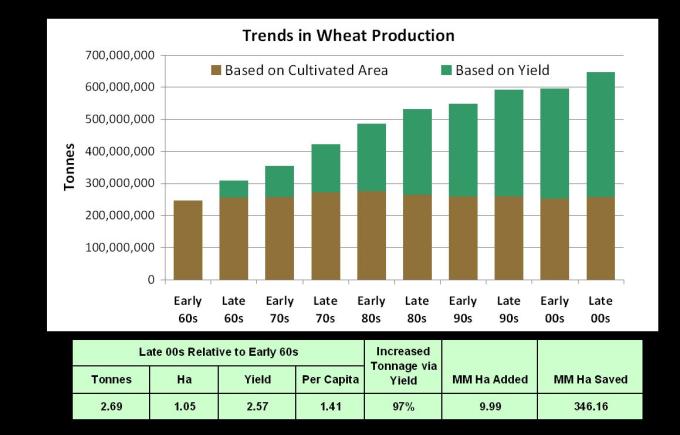
The global wheat industry is really made up of many distinct sub-crops, but as a whole, wheat production has been making steady progress in keeping up with growing global demand with only minimal expansion in planted areas (see graph below).  Some of that progress has been made by diminishing pest damage through a combination of breeding and crop protection agents like fungicides.  Also, a great deal of modern wheat production is in “no-till” systems where weeds are controlled with herbicides instead of by mechanical tillage.  This system greatly reduces soil erosion, lowers fuel use and leads to improved soil health and carbon sequestration.
image003
The green part of each par shows the proportion of the increased production achieved through higher yield rather than additional planting area
So the next time that you enjoy a wheat-based product, think about the effort and risk that a wheat farmer faced, not only to produce the grain, but to produce it with the positive qualities needed and with the absence of issues like DON toxin.

reade more... Résuméabuiyad

Why The Current Round Of Ag-Chem Consolidations Worries This Agricultural Scientist

This no-till field is good for the environment and the food supply.
Such innovations involve many expert contributions

I am concerned that we may be on the verge of a major loss of knowledge and experience in the agricultural sector. In the 40 years I have worked with agricultural technology companies I have witnessed many changes. There was a major round of consolidation in the late 1990s and that is happening again today. There are reasons that these trends can make business sense and can be good for shareholders. There can also be problematic aspects of consolidation. Many expressed concerns with antitrust issues in the Monsanto-Syngenta connection, which didn't end up happening, and now with the Dupont-Dow merger, which looks like it will.

That isn't what worries me -- it will still be a competitive sector. I'm concerned about a likely loss of expert knowledge about agriculture.

When companies merge there is a seemingly irresistible financial incentive to get the most experienced (and thus highly paid) employees to take early retirement as a way to deal with "redundancies." Perhaps this won't be as much of an issue with Syngenta, a chemical discovery and biotech company that agreed Wednesday to be bought by ChemChina, a generics player. However, if the retirement strategy is employed in this or the rest of the current wave of consolidations, it will lead to a loss of deep knowledge and experience that could not come at a worse juncture in the history of the food supply.  (Let me be clear that I have no insider information about any of the pending deals or corporate employment plans.  I have consulted across the industry since 1996, but at the mid-level technology level, not in corporate strategy or financial circles).
Between 1960 and 2010, agricultural output increased mainly through higher yields.
That required a great deal of technical and farmer innovation driven by knowledge
(based on FAOStats data)

Global agriculture is a diverse and complex phenomenon that involves unique challenges and unpredictable risks. The extraordinary success of this industry in meeting food demand while improving sustainability relies on a combination of business understanding and technical knowledge that is not easily learned. People with decades of experience on either the business or science side (or often both) are critical to negotiating the threats and opportunities before us. It will be far from trivial to meet the food demand of the growing population and the consumption desires of the expanding middle classes in previously poor regions. To do this without needing to expand the base of farmed land will require talent and expertise. This increased demand is happening with the added uncertainty of climate change and the spread of "exotic" pests in an ever more connected world. A major wave of retirements could seriously compromise our resources of skill, experience and wisdom needed to meet these challenges.

This likely retirement scenario is even more concerning because of the lack of new, skilled talent coming into the agricultural industry. Ag technology companies have been having an extraordinarily difficult time finding qualified new hires because very few young people today are interested in the scientific fields that are critical for agriculture (entomology, agronomy, soil science, plant pathology, plant breeding...).  I don't know the reasons, but I suspect that the widespread demonization of "industrial agriculture" has much to do with this phenomenon. As it is, companies are having to hire people with other degrees (e.g. environmental sciences or even the humanities) and train them from scratch. That isn't impossible with bright and willing people, but if many of their best potential mentors are departing, it becomes far more difficult.

I don't want to imply that the sky is falling. There are still a great many talented people who will be involved in advancing agricultural technology.  However, I do think that the industry and/or society needs to consider some creative ways to allow continued access to the collective experience of those who may soon "retire".  Consulting or some sort of part time "emeritus" status might be possibilities, but those can have tax and retirement income problems. For many industries we would be wise to fix our system so we don't dis-incentivize a graceful wind-down of careers. Perhaps some of the retirees can be hired by other AgChem companies who need their expertise. With modern life expectancies, retirement in one's 60s can easily mean 20 years of lost contribution potential.  It's not that I begrudge my slightly older colleagues a well deserved rest or the chance to start a new chapter in their lives. I just don't want society to lose the unique aspects of what they know.

Your thoughts and comments are welcome here and/or via email (savage.sd@gmail.com)

reade more... Résuméabuiyad

The Missing Party In The Discussion About Sustainable Farming

Lots of our prime farmland is rented

(This post originally appeared on Forbes, 7/15/15)

The good news is that state-of-the art sustainable farming practices can pay for themselves.  When fields are tended in a way that improves soil quality over time, there are multiple environmental benefits in terms of water quality, greenhouse gas emissions, and energy demand.  At the same time, this kind of farming increases the value of land through increased productivity and greater drought resilience.  The not so good news is that farmers rent much of the land they farm, so they don’t fully benefit from the financial up-side of this sort of sustainable farming.  And typically, those that own the land are far removed from the details of farming.  I believe that this disconnect and misalignment of financial incentives is a key barrier to the fuller implementation of the kind of farming that could meet both our environmental and food supply goals.

Maybe You Can’t Buy The Farm, But You Can Rent It

There are historical and logical reasons why so much farmland is rented.  As mechanization steadily reduced the number of people needed to produce food, the descendants of previous farming families tended to retain ownership of the land even after they had migrated to cities.  Those who continued to farm found that it is better to expand their operations by renting land rather than through buying.  With the unpredictable ups and downs of commodity prices, a big mortgage puts a farmer at too much risk of bankruptcy.  Also, the price of land can vary for many reasons unrelated to its potential crop production (development potential, mineral rights…), while land rents are very tightly connected with the likely crop value (see graphs below).  Renting land also makes sense for the owners because it represents a steady stream of income.

How land rents are related to potential productivity for 4 Midwestern states

However, even though the leasing of farmland is a practical system, the way it is typically done today misses the opportunity for a win-win-win scenario for the farmer, the land owner, and the environment.  There are different kinds of leases, but a widespread arrangement is a simple annual cash rent.  The farmer pays a set price for each given year with no guarantee that they won’t be outbid for that particular property the next year.  This focuses farming decisions on short term economics.  For instance the prevailing rents in any locale are usually based on the income potential of and risk profile of a few crops.  Thus in much of the heart of the American Midwest, a corn/soy rotation or even continuous corn is what is needed to be able to pay the rent and still make a little money.  There might be good agronomic reasons to include something like wheat or a forage crop in the rotation, it isn’t feasible because those crops are not worth as much, and in the case of wheat, have a disease risk issue.

Land Rent is a major part of the farmer's annual cash outlay
The optimal, soil-building farming methods I mentioned above often take a few years to produce their beneficial effects, and entail some risk along the way.  There is a several year transition from a plow-based system to no-till or other reduced tillage system.  There is a need for new equipment and for the first few years there can be higher risk if the planting season is wet or cold.  After a few years the risks become lower than with tillage, but without a longer-term lease arrangement, the initial investment does not make sense.  There are similar pay-off delays for other best practices like cover cropping and controlled wheel traffic.   The prevailing, annual cash rent arrangement as well as annually focused lending don’t support these sustainable practices.


Land rental is big business
Over the past several years there have been a number of very well intentioned, multi-stakeholder initiatives which have sought to establish objective, quantifiable metrics for agricultural sustainability with the idea of encouraging positive options.  The parties at the table have included environmental NGOs, food manufacturers, food retailers, technology companies and farmer organizations, but to my knowledge there has been no one at the table representing the interests of absentee land owners.  This is unfortunate because it is their land asset, which has the potential to increase in value.  What is needed is a way for farmers and land owners to share the risk and investment of the shift in practices and then to share the increase in potential production value.

This issue of misaligned incentives on rented farmland is one of my "concerns about the future of the food supply,” but I believe it is something eminently solvable.  I know there are plenty of progressive farmers who would be able to make the right decisions about how to improve each given field.  I believe that if the distant land owners could be informed about the potential, many of them would gladly engage.  There is probably a role for an environmental NGO to help bridge that divide in our society.  The progress could also be documented by a multi-stakeholder agreed upon sustainability metric.  Any ideas about how to make this happen are welcome!

reade more... Résuméabuiyad