Pages

.

Showing posts with label Fresh Produce. Show all posts

Yes, We May Have No Bananas, But Monoculture Wasn't So Easy To Avoid

(This article originally appeared on Forbes, 1/4/18)

Standard retail banana display - photo by Steve Hopson via Wikimedia Commons

In 1923, Frank Silver and Irving Cohn published a song that became a major hit for the Billy Jones Orchestra, with the signature line “Yes, we have no bananas; we have no bananas today.” It turned out to be sadly prophetic as, in the 1950s, the banana trees that supplied the entire global banana export business were wiped out by a soil-borne fungal disease known as “Panama Wilt.”

The industry at that time was almost entirely based on a single banana cultivar called “Gros Michel” (meaning “Big Mike”), and it was susceptible to infection by a strain of fungus called Fusarium. Once the soil of a given plantation was contaminated with that strain, any Gros Michel tree grown there would soon die.

By good fortune, a different banana cultivar that was being grown in the South Seas was able to substitute for Gros Michel as a commercial line, and this new “Cavendish” cultivar became the new banana of international commerce, as it remains to this day. (Check out this interesting blog post about the history of the Cavendish variety and how it actually passed through a greenhouse in England in that process! And here is another good post about the history of this disease and the industry.)

Unfortunately, it's about time for some band to cover “Yes, We Have No Bananas” because, evolution being what it is, a new strain of Fusarium — Tropical Race 4 — has arisen and it is lethal to the Cavendish. The disease is slowly making its way around the world, and since it can be spread in a particle of dirt on something like a boot, it will almost inevitably make it to the Central and South American growing regions that supply both North America and Europe with their bananas.

Although this unfortunate scenario has been on the minds of the banana industry for decades, it is now starting to get more attention in the mainstream press. One part of the story that has been shocking to these outside observers is that such a huge industry would ever be dependent on a single cultivar of banana. As Stephen Mihm put it for Bloomberg, this looming “bananapocalypse” is attributable to a vulnerability that comes from the practice of “extreme monoculture.”
While I understand why observers might be shocked that a nearly $12 billion industry depends almost exclusively on the Cavendish banana, I do want to push back on the implied conclusion that this represents some sort of irrational or irresponsible expression of “big ag” or whatever other demons are imagined by the Food Movement.

Banana tree dying from Panama Wilt (Photo by Scot Nelson)

When you see something that is a standard practice in a very large, nationally diverse and multi-company business like bananas, I would suggest that it is appropriate to ask not “what is wrong with this system” but rather, “What are the practical factors that drive this seemingly irrational practice?”

I’m not a banana expert, but in the mid-1990s, two of my first jobs as an independent consultant had to do with the banana industry. It was during the exciting early years of commercial plant biotechnology, and many industries were asking, “What might this new technology do for our business?” Both of my projects involved early-stage discussions between a major banana company and a plant biotech company — four different entities in all. These were “drawing board stage” projects, with the goal of figuring out if certain ideas could ever make economic sense: Would they be something worth years of effort and millions of dollars for research? Still, overall, biotechnology looked like a way for this industry to tap into genetic diversity.

The fun part for me was getting to do a deep dive into the details of how bananas are grown, handled, shipped and marketed. I got to travel to Honduras, Costa Rica and Ecuador to tour banana plantations and interact with experts at the major banana export companies. As I said, I’m not an industry insider, but I think I can shed some light on why there are not more kinds of bananas grown for export.

As modern consumers, we are offered an amazingly diverse selection of fresh fruits and vegetables year-round, so it is important to think back to the early days of this offer of plenty. Having grown up in Denver in the 1960s, I can recall that, except for a few summer months, almost the only fresh fruit options at the grocery store were bananas, apples and oranges. I have a podcast about why apples were ever on that list. But if you think about it, the very fact that we can so easily enjoy fresh bananas in temperate regions is a bit remarkable.

Bananas can grow only in regions where there is never frost, and they do best in truly tropical climates. How did a tropical fruit become a mainstream, reasonably priced, healthful, kid-popular fruit for people who experience winter?
In tropical regions, there is a great deal of genetic diversity among wild bananas and considerable diversity among the banana or plantain types that humans cultivate. However, very few of these bananas could ever meet the criteria needed to be a viable export crop.

A typical wild banana with seeds (image by Mkumaresa via Wikimedia Commons)

First of all, a banana for export has to be seedless. Many wild bananas have large, very hard black seeds – not something that has much consumer appeal. The bananas that people like are seedless because they have triploid genetics – three of each chromosome vs. the two that we have. That is the same way we get seedless watermelons, grapes, etc. It's not some “GMO” thing; it happens at times in the plant kingdom, and we humans like it! Still, improving or changing the cultivar through “conventional breeding” isn’t an option if it makes no seeds.

Next, the banana needs to be productive in terms of overall yield per tree or acre. I’m sure no one in the 1920s was calculating it, but in modern “sustainability” thinking, the “land-use efficiency” of a crop is an important criterion. That, along with “water-use efficiency,” small “carbon footprint” and “energy footprint,” is all very much tied to good yield. The usable per-hectare yields of the Cavendish variety are quite high, and that is why it has been a both economically viable and environmentally sustainable choice for a long time.

But probably the most limiting requirement for a banana variety to be commercially acceptable is that it has to be shippable. In the modern era, we have lots of transport options for food products, but during the era when the banana was becoming an item of international trade, the only viable option was ocean shipping. A product being moved from the tropics to North America or Europe needed a very-low-cost transport option if it was ever going to be a mainstream consumer product. Most fresh produce products loaded onto a ship for a two-plus-week trip to a northern port would be a soup of decay by the time they arrived.

What made the Gros Michel and its successor, the Cavendish, remarkable was that they could make that trip at a temperature range of 55-58 degrees Fahrenheit, and so not even require lots of energy for refrigeration. Very few of the wonderful range of cultivated or wild banana types could ever do that, but because the Cavendish can be shipped this way, the energy and carbon footprint of its shipment is small. This crop has a very attractive "food-miles" profile.

Banana Black Sigatoka infection (Image by Scot Nelson)


In addition, it turns out that the conditions under which bananas grow can affect their shipping potential. There is a disease that infects only the leaves of banana plants called “Black Sigatoka.” If a banana tree has suffered too much of that infection, even the robust Cavendish variety won’t be able to make the trip by sea. One thing I learned on my tour was that plantations have employees whose whole job is to survey the plantation on a tree-by-tree basis in order to qualify the fruit for shipment based on how well that disease has been managed.

But it gets even more complicated than that (here's a good video summary of the process). Bananas are picked in Central and South America at a “green” stage — imagine a fruit more completely green than the greenest one you've ever seen in the clusters in your store. When they get to their destination, they are put into “ripening rooms,” where they are exposed to ethylene gas to start them on the way to the ripe yellow fruit you know. Before you freak out, know that ethylene is the fully natural plant hormone that induces ripening in most fruits and vegetables.

There is a definite art to this ripening process, and highly valued experts who can assess each shipment of bananas know just how to handle them in the “ripening rooms” to achieve the goal of delivering “just right” bananas at retail. This process has to factor in issues like ups and downs in demand and turnover rates at key retail customer outlets, in addition to the condition of the incoming fruit.

I know that at the stores where I shop, I can consistently buy bananas that are close to ripe but not fully, such that I can hope to consume them all before they turn black. We consumers might think we have a balancing act to do when it comes to timing ripening and consumption of the bananas from our counters, but imagine that on a huge scale for the banana distribution chain.

There is one more critical element of the business model: Those ships that come to our ports loaded with bananas certainly can’t go back empty. The banana shipping companies are also seriously involved in their “back-haul” business of bringing back products of interest in the source countries. Having a well-understood, predictable crop helps with running that business efficiently as well.

So for the international banana business to work in a way that provides a relatively low-cost product acceptable to consumers, it needs to be able to function in a reliable and predictable fashion. Figuring out how to do this with a new banana variety would be a huge challenge. How do you grow it efficiently? Can the crop make the trip reliably? How can its ripeness be managed in order to meet both the distribution chain requirements and the needs of consumers for decent “counter life”? Will all of this work in a way that is compatible with a viable back-haul business?

So while it is easy to think that the banana industry is crazy to depend on one cultivar, I submit to you that it is not without reason and it implies no irresponsibility.
So does that just mean that we are inevitably going to live out the unintended prophecy of “yes, we have no bananas”? I think that depends on whether we continue to live in a world where anti-biotechnology groups are able to exercise the control that they currently have over our food system.

Let me explain. Remember that my introduction to bananas was based on excitement about what biotechnology could do for the crop. One of the concepts was to develop bananas that were resistant to that leaf infection disease that can compromise shipability. Control of that disease requires something like 40 fungicide sprays a year, so as you can imagine, there would be a huge cost savings if the trees could be made resistant.

The other concept on the table was modifying the banana so that it would stay in that nice yellow, but not yet black, stage longer on the consumer’s counter. I’ll never forget that in the first meeting about that idea, a participant who worked for a UK-based banana importer said in his very British accent: “Why would you want to do that? Don’t you know that the dustbin is a major consumer of bananers?” Obviously he wasn’t attuned to current sensitivity to the need for food waste reduction. I thought it was cool that a banana company was serious about an idea that might reduce food waste, with the hope that it would make consumers more comfortable about buying even more bananas.

Well, these were just theoretical ideas at the time, and they didn’t go anywhere because it soon became evident that the anti-GMO forces were quite successful at putting brand-sensitive companies in an untenable spot if they were using “GMO crops” not just for generic ingredients but for brand-central crops. A dramatic example was how fast-food chains like McDonald's moved to avoid biotech potatoes for their signature fries.

It quickly became clear to the banana companies that their brands and their retail store access could be compromised if they pursued “GMO” options. The irony here is that this would have been the most viable strategy with which to bring genetic diversity into the logical but extreme monoculture of bananas.

So the irony is that if the “yes, we have no bananas” scenario becomes a reality, it will be because we as a global society didn’t use a safe, viable, scientifically sound strategy to rationally deal with the problem in the banana crop.

Public institution scientists in Australia and entrepreneurial scientists in the Latin America have come up with ways to modify commercially relevant bananas to resist the Fusarium disease. Ideally there would be the potential to use several approaches, either in the same banana or in different fields; that would avoid delay selection for resistance and avoid yet another dependency on a single line. It is likely that the "heritage variety" Gros Michel could be made commercially viable once again!

If the Fusarium-resistant biotech bananas were introduced, activists would almost certainly attack them as “GMO.” Would any of the big banana companies have the guts to move forward with the technology in spite of the inevitable brand attacks by NGOs? Would any big food retailers be willing to resist the inevitable pressures not to stock that fruit? That retail blockage strategy is being used today against other new biotech offerings such as non-browning apples and potatoes and fast-growing, terrestrially raised salmon.

At one level, this is a question about what will be available for us as consumers. Will we continue to have this highly consumed, reasonably priced, child-friendly, healthy food option? Maybe not. But there is another big question.

One thing I witnessed on those visits to the banana industry back in the '90s was that large communities in Central and South America flourish because of the jobs that this industry creates. We in the rich world will still have lots of other fruit choices if the stores have no bananas, but that flexibility isn’t there for the families that have been doing the work to provide us with this staple food option for so many decades. I would think that most activists are the kind of people who care about the availability of healthy, low-cost fruit options; I doubt that they would want to see the banana-producing communities impoverished. However, if the current paradigm of anti-GMO intimidation of fruit companies and retailers continues, that is where we are headed.

#yeswehavenobananas

You are welcome to comment here and/or to email me at savage.sd@gmail.com


reade more... Résuméabuiyad

Conventional Produce Is Not Dirty, But The Marketing Tactics Of Big Organic Are

Spinach - a crop that is getting a bum rap (picture by Victor M. Vicente Selvas)


(This post originally appeared on Forbes on 3/13/17)

For each of the last twenty years, an organization called the Environmental Working Group has issued what it calls a “Dirty Dozen List.” It names crops it claims to have high pesticide residues and recommends that consumers purchase organic versions of these crops. They base their list on a seriously distorted interpretation of a taxpayer-funded testing program called the PDP (Pesticide Data Program, USDA). What the PDP actually documents is that our food supply is extremely safe. EWG has repeatedly been called out for promoting this science-free list and for the counter-productive effect it is having on produce consumption by Americans. Yet, EWG persists in employing this strategy as a means of fund raising. Presumably it also serves the interests of their corporate funders in the organic food industry (see list below).  Note that these are very large, processed food players with only one produce company in the list.


The real "dirty dozen"

In its latest campaign, EWG is singling out a few crops for added demonization – notably spinach. They highlight certain specific chemicals that were detected in spinach samples by the USDA in 2015. I have looked in detail at this same, publicly available data. It turns out that 7% of the 2015 spinach samples were organic. The very same chemicals that EWG choses to talk about were found on those organic samples. As with virtually all of the residues found on all crops, the quantities that the USDA analytical chemists found were at very low levels - well below any possible level for health concern. Still, it is ironic that the same flawed logic that EWG uses to scare consumers away from perfectly safe conventional spinach says that they should also avoid the organic alternative.


Bagged Baby Spinach (CCO Public Domain)


Experts agree that one of the best things we can do for our health is to consume a lot of fruits and vegetables (here is one example of why that makes sense). Sadly, all too few Americans do that. Spinach is one of the more popular vegetables that can help move consumers in the right direction, particularly since it has become available as a convenient fresh, pre-washed option. Discouraging consumption of any kind of spinach is a notably irresponsible thing to do, particularly through disinformation. An industry group that represents both conventional and organic produce companies (and many are both) offers an on-line calculator using the USDA’s data and legitimate toxicological information. With this tool consumers can visualize just how safe products like spinach actually are. For instance, a child could safely eat up to 310 servings of spinach a day without negative effects from the trace chemicals on that crop.

Aphids on spinach (Image by demintedmint)
As I wrote last week, organic and conventional produce are actually quite similar when it comes to the presence of low levels of pesticide residues. Because EWG singled out spinach in its recent fund raising email campaign I thought it would be worthwhile to get into the details for that crop.

For instance, EWG focuses on the synthetic pyrethroid insecticide, permethrin, which it calls a “Neurotoxic bug killer.” That sounds scary, but pyrethroids all have the same mode of action as the natural product called pyrethrin derived from Chrysanthemums (pyrethrin is used on organic crops).  As a class the pyrethroids are only slightly toxic to mammals and are considered safe enough to be in many household, garden and pet products sold to consumers.  One of the synthetic versions, Permethrin, is among the most used crop protection agents on spinach to prevent damage from caterpillar pests and infestations with aphids. These are not things we would like to find in our salads!

The USDA detected an average of 0.8 parts per million of permethrin on the 2015 conventional spinach samples. That is only 4.2% of the conservative tolerance set by the EPA, meaning it isn’t even close to something to worry about. On the organic samples from the same season, the USDA detected an average of 0.9 parts per million permethrin– essentially the same level as with conventional.

EWG also calls out the fact that traces of DDT and its metabolites were found in some spinach samples. These are unfortunate, long-term soil contaminants still slowly decomposing decades after that old product was banned. Their presence is certainly not related to whether the current spinach crop is grown conventionally or under the organic rules. Fortunately, the levels are tiny – seven parts per billion for the conventional and 11 parts per billion for the organic. These are only 1-2% of the level that the EPA considers to be of concern.

Permethrin and DDT are the products detected on spinach that the EWG chose to talk about. There were residues of 30 other synthetic pesticides on the organic spinach in 2015. The USDA does not test for at least two dozen other organic-approved pesticides that are used on spinach (biocontrol agents, mineral compounds, natural product chemicals). None of this means that organic spinach is “dirty.” Conventional spinach isn’t “dirty” either. What is “dirty” is the tactic is telling consumers they need to buy organic because of residue concerns without acknowledging that the organic products have similar, low-level residues.
In my opinion the "Dirty Dozen" should refer to the eleven big-organic companies that support the EWG and the EWG itself.

You are welcome to comment here and/or to email me at savage.sd@gmail.com


reade more... Résuméabuiyad

Organic Might Not Mean What You Think It Means

(This post originally appeared on Forbes 3/6/17)

Organic might not mean what you think it means.  Recent data generated as part of the USDA’s Pesticide Data Program (PDP) shows that there are detectable, low level pesticide residues on organic fruits and vegetables. This isn't surprising information.  It echoes results from previous PDP testing and with more comprehensive testing of organic samples in 2001-11 by the USDA and 2011-13 by the Canadian Food Inspection Agency. What is interesting is that while the incidence of residue detection is somewhat lower for organic, the very low levels of chemicals found are quite similar to the low levels detected on conventional samples. The 2015 PDP study found residues of 68 different pesticides, pesticide metabolites, or plant growth regulators on organic fruits and vegetables.


Red organophosphates, Blue carbamates, Green organochlorines from historical use


For 37% of these chemicals the average residue on organic samples was actually higher than the averages on conventional, but still very small.
What really matters is that the levels detected for both kinds of produce are below the “tolerances” that are set by the EPA and those tolerances already reflect a generous safety margin.  

So, what these data really tell us is this:
“Yes. Skilled analytical chemists can detect tiny amounts of synthetic and natural pesticide residues on organic and conventional produce. In both cases the level that are found are below to well below any threshold of concern. Our regulatory system is working. Those who grow our food are well trained and are following the rules designed to both enable crop production and protect the public. Enjoy your safe, healthy, delicious options!”

Background on the PDP


Each year the USDA gathers and analyzes around ten thousand samples from the mainstream US food supply – mainly fruits and vegetables. In the sampling process, USDA ends up including some items labeled as USDA Organic (349 samples in 2015, 4% of the total). USDA labs then look at all the samples for residues of crop protection chemicals using extremely sensitive analytical methods.

USDA provides both brief and detailed summaries of this information, but I appreciate the fact that the raw data is transparently available to the public so that I can look through it myself (it is bit challenging because there is a two million+ row main table, a 10 thousand row sample table, and 18 reference tables). I looked in detail at all the pesticide detections and also looked at the testing results for produce samples that were being sold with the organic claim.

What Was Found?


As with the overwhelming majority of samples, the residues detected on the organic items are at levels below the conservative “tolerances” that are set by the EPA. Yes, residues are present. No, they are not a safety problem. However, the presence of residues does conflict with what many consumers have been led to believe about the difference between organic and conventional.

Many people think that organic means “no pesticides.” That is simply not true. Organic farmers can and do use a range of allowed pesticides because they too have to deal with pests. The list of organic-approved pesticides is not based on safety criteria but rather on whether or not they can be considered “natural.” Again, in spite of much misleading marketing, “natural” does not automatically mean safe. In fact the USDA which is in charge of organic certification specifically states on its website that “our regulations do not address food safety or nutrition.”

As with all pesticides and other crop protection products, it is the EPA which assesses which pesticides can be used safely, and within what constraints.

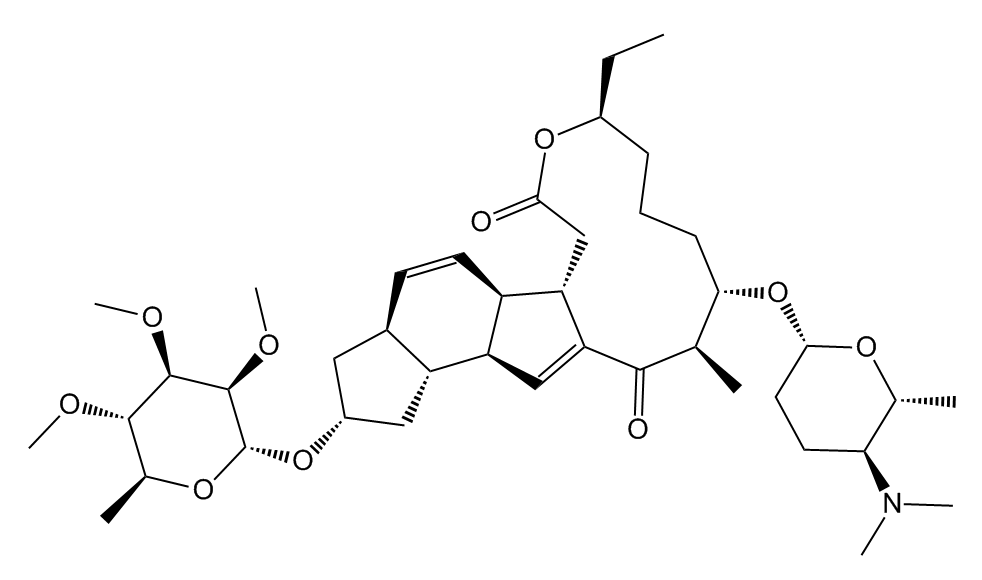
So what sorts of residues are found on the organic samples? The most common detection is of an insecticide called spinosad. That is an effective control for a variety of caterpillar pests and is produced through a microbial fermentation process, thus allowing it to qualify for use in organic (see chemical structure of one of the spinosyns below). Just to be clear, the spinosad products are produced by the Dow chemical company.

Chemical structure of a spinosan (Image from Cappacio)
Conventional farmers also make good use of this and other natural products. Spinosad is really the only natural product pesticide that is detected in the USDA’s monitoring program. Other widely used products like sulfur, petroleum distillates, copper salts and microbial products can’t be monitored using the same, highly sensitive and cost-effective tools that allow the USDA to generate the more than two million test results they generate each year. If specific tests were conducted for those natural products, the number of residues detected per organic sample would probably be much larger – but it wouldn’t really change the overall conclusion that these foods are safe to enjoy.


Other than spinosad, the remaining 80.2% of residues detected on organic are of “synthetic” chemicals.

Graph by author

While very few of the synthetic materials used in agriculture today are intrinsically very toxic to humans, they are theoretically not supposed to be present on organic because they are not on the list of approved, natural options.

There is however a rule in the organic certification system that any residue present at 5% or less of the USDA tolerance will be considered “unintentional” and thus not a reason to deny organic certification. 62.1% of the 2015 organic detections met that criterion, but interestingly so do 74.6% of the detections on non-organic samples from the US and 70.1% of the detections from imported, non-organic samples. Not so different.

Another 15.6% of residues detected on organic technically violate the organic rules by being over 5% of EPA tolerance, but such residues are still fully safe based on EPA criteria. That same safety criterion applied to 23.0% and 25.2% of conventional US and imported samples respectively. For both organic and conventional there are a few detected residues of products that don’t have a specific, assigned tolerance for the crop in question. These are generally very low-level detections, so while they represent technical violations they are not of real concern and once again, similar for organic and conventional (average “no tolerance” detection for organic 23.7 parts/billion, average for conventional imports 19.8 ppb, and average for US conventional 17.2 ppb).

To reiterate, what this transparent public database tells us is that our food supply is safe from the perspective of pesticide residues. This means that our regulatory system is working and that thousands of farmers in the US and elsewhere are doing a great job of managing pest damage while still protecting our health. The data also tells us that there are some striking similarities between organic and conventional when it comes to residues. What the data also tells us is that as consumers we should reject some of the misleading marketing and advocacy efforts of certain irresponsible elements of the organic industry. Instead of giving in to those fear-based campaigns we should feel the freedom to choose healthy and delicious produce using important criteria like freshness, flavor, quality and affordability.

There is a site you can use to visualize the PDP data http://www.cropaudit.org/

You are welcome to comment here and/or to email me at savage.sd@gmail.com


reade more... Résuméabuiyad

Do You Really Need To Worry About Pesticide Residues On Your Food?


fresh fruits and vegetables
Some of the healthy fruits and vegetable we can enjoy (Image from Wikimedia)
Many Americans have concerns about pesticide residues on food – particularly for fruits and vegetables. In contrast with that oft-communicated perception, the safety of our food supply is well documented. One reason for this disconnect is that there are activist groups (non-governmental organizations) that consistently promote the idea that consumers should buy organic versions of certain crops in order to avoid pesticidesA recent study documented how that sort of message induces some lower income Americans to simply avoid fruits and vegetables all together. The truth is that our food supply is extremely safe because farmers are careful to use pesticides in ways that don’t lead to residue problems at the consumer level and because of rigorous regulation followed by farmers over the last several decades.
The common perception of organic as a safer option in this regard is also at odds with reality. The United States Department of Agriculture (USDA), which oversees organic certification, clearly states on its National Organic Program website: “Our regulations do not address food safety or nutrition.” Organic farmers can and do use pesticides from an approved list, but that list is not based on safety criteria. Organic growers are limited to natural chemicals and to a limited list of synthetic materials. As with any crop protection material, the EPA has the responsibility to evaluate and regulate their safe use. That oversight is why consumers can confidently enjoy both conventional and organic foods.
In this post I will describe the testing, regulatory and training systems that are in place in the US to protect consumers from risks associated with pesticide residues. I will also describe the intense monitoring system that demonstrates year-after-year that this system is working.
All farmers face challenges from a variety of pests and although they use a number of methods to manage those threats, pesticides are a critical part of that “toolbox.” The broad category “pesticide” includes certain chemicals that occur in nature as well as various synthetic chemicals. There are also pesticide products based on living biological agents. The responsibility for pesticide regulation is with the Environmental Protection Agency or EPA. It determines how pesticides can be used safely, based on their particular intrinsic properties, and by restrictions on how and when they can be used.

EPA Risk Assessments

Before any new pesticidal product can be sold in the United States, an extensive list of toxicological tests must be performed and reported to the EPA. The company that makes or which will sell the product is responsible for the cost of this testing, but most of the work is performed in contract labs that are closely audited by EPA. The tests evaluate many different facets of potential toxicity for human and environmental health, both in terms of short-term effects (acute toxicity via consumption, by skin exposure, by inhalation exposure…) and long-term effects on development, organ health, reproduction, and potential carcinogenicity. In addition, a great deal of data has to be generated to show what happens to the chemical over time on the food, and in the environment in terms of its persistence, movement, and breakdown into innocuous ingredients. It costs on the order of $286,000,000 and can take more than 10 years to generate all of this required data. EPA then uses these data to conduct an extensive “risk assessment.” Based on that assessment, EPA develops “label requirements” specifying how, on which plants, when, and how much of the pesticide can be used. These risk assessments cover issues of worker safety, environmental impact and also what sort of residues might be left by the time the crop is harvested, and any potential risk to human health.
6-image
Some safe, delicious apples ready for harvest in western Washington this summer

Pesticide Tolerances (or MRLs)

With regard to pesticide residues at harvest, EPA designs the label requirements to make sure that any residues still present when the food gets to the consumer are below what is called a “tolerance.” (Outside the US this is called an MRL or maximum residue limit). The tolerance is set to insure that there is a substantial margin of safety (typically 100-fold) between the allowed residue and any level to establish reasonable certainty of no harm to humans. EPA then sets limits on how much of the pesticide can be applied and how close to when the crop is going to be harvested so that the tolerance is unlikely to be exceeded when farmers use the product.
These tolerances are very conservative limits and represent such small amounts that they can be difficult to envision. For instance, a tolerance might be five (5) parts per million. That can be visualized as to two drops of water in a five (5) gallon carboy. Some tolerances are set as low as one part per billion (e.g. one drop in 528 carboys). In summary, tolerances are extremely small levels of pesticide residue, set as a conservative standard for human safety, and customized to the specific properties of the each chemical.

Training

In order to be allowed to apply pesticides, farmers have to be trained and certified about how to comply with the chemical-specific label requirements. They have to maintain that training through on-going classes.

Is the System Working?

Every year, as part of a USDA effort called the Pesticide Data Program (PDP), thousands of food samples are randomly gathered from normal food channels and consumer markets. The samples are taken to labs where each sample is screened for the presence of hundreds of different chemical residues. The data that the USDA generates is transparently published both in raw and summarized form. Year after year, what the data show is that the system is working! The vast majority of samples have either no detectable residues or residues that are below the assigned tolerances – mostly far below. The fact that a small residue can be detected does not mean it is of concern. Modern analytical chemists have the ability to detect chemicals at very low levels. The reason that the numbers below tolerance are still published is not that they are of concern, but rather as transparent documentation that these products should be of little concern to consumers and regulators.  Several governmental agencies evaluate this information each year and confirm that consumers can confidently enjoy their food supply without concern about pesticide residues. The results were just released for 2015 and again document how well the system is working.  The FDA also has a residue testing program from which it concludes, "Results in these reports continue to demonstrate that levels of pesticide residues in the U.S. food supply are well below established safety standards."  California does its own residue testing and concludes, "California tests show low or no pesticide levels in many fruits and vegetables." Similar residue testing is conducted in Canada and the EU with equally encouraging results.  With this overwhelming body of evidence, how can the fear of residues persist?

What About the “Dirty Dozen List?”

Unfortunately, each year there is an organization called the Environmental Working Group (EWG) that takes the USDA PDP data and grossly misuses it to create a “Dirty Dozen List.” Instead of looking at how detections relate to carefully developed tolerances, EWG essentially treats all detections as significant – an approach that has been completely rejected by independent experts in the field of toxicology. EWG then recommends that certain crops be sought out as organic. Similarly misguided recommendations to purchase organic are published Consumer Reports. This makes no sense, since organic is not a safety certification. In fact, organic crops often have the same sort of low-level, detectable residues of pesticides as conventional (example data from the US and Canada). This point is conveniently ignored by these organizations.
In conclusion, we have a system in the US that both enables farmers to control pests and which protects consumers so that they can enjoy healthy foods without worrying about pesticide residues.

You are welcome to comment here and/or to email me at sdsavage@gmail.com


reade more... Résuméabuiyad

The Non-GMO Food Label Is A Lie


(This post originally appeared on Forbes 6/11/16)
You may have noticed more and more food items being marketed as “Non-GMO Certified.” As Americans, we are familiar with food being sold for what it is not, so we don’t think much about the fundamental absurdity of this new labeling.
After decades of being sold “non-fat,” “zero cholesterol” or more recently “gluten-free,” this looks like just one more marketing claim. In fact, the non-GMO label is fundamentally different because it is based on an entirely false assumption.
The truth is, virtually all the foods we eat have been “genetically modified,” and often in dramatic ways. The widespread belief that our food still resembles what our ancestors domesticated out of “nature” is only a demonstration of how little we understand history and science. However, the Princess Bride meme above is pertinent, because this new appeal to our ignorance is definitely coming from “someone who is selling something.”
How some crops looked before they were domesticated.  Lots of genetic modification involved, just not understood when it was done

Recently, I saw an ad in a trade magazine that compelled me to go tilt with the windmill that is “non-GMO” labeling. The ad was promoting the potential “Texas-Sized Sales” of bags of Sweet Scarlett’s grapefruits. I love those grapefruits. They are tasty and sweet, a beautiful red color, and seedless. I’m happy that my favorite stores carry this excellent product. But at the bottom of this particular ad, I noticed the logo declaring that these are “Non-GMO Project Verified.” That crossed a line for me.

These delicious grapefruit varieties are a textbook example of how crops were genetically modified back in the 1960s and '70s using a method called “mutagenesis breeding.” Basically, seeds (or in this case pieces of budwood) were exposed to gamma radiation in substantial doses, and then sifted through to find ones with mutations to their DNA that had desirable qualities. You don’t get much more “genetically modified” than that! That positive plant breeding story could certainly be made to sound scary in terms of unintended consequences, but in fact, thousands of modern plant varieties were modified this way. To date there is no track record of bad effects on consumers. There are now far more precise and controlled ways to genetically modify crops, but only certain new methods have been singled out for opposition as “GMOs,” while clumsy old methods, like mutagenesis breeding, escape this demonization.

So my problem with calling these grapefruits “non-GMO” is simple. These fruits are absolutely “genetically modified." To call this product non-GMO is a lie. That is true for most other non-GMO labels. These are also lies that dovetail with another long-term lie that has been widely disseminated in the Internet age - a “lie with pictures.” I'm talking about the widely used, stock-photo images illustrate of ready to eat fruits and vegetables stuck full of large hypodermic needles that are used in campaigns against “GMO food” Those images bear absolutely no resemblance to how plants are genetically engineered, but they are a powerful lie that has been quite effectively used to manipulate consumers.
What is truly disappointing is that the non-GMO “labeling lie,” and its inevitable connection to the photo-lie, is officially sanctioned by the very federal agency charged with truth in labeling for foods. In its guidance document on the subject, the FDA says that while it “prefers” more accurate wording on labels, it “will not pursue enforcement actions” with regard to the use of the “non-GMO” terminology. Thanks for protecting us from inaccurate labeling, FDA.

The disease that threatens these grapefruits and all citrus is already in Texas

There is another reason that this particular kind of disinformation is a problem. The grapefruit farmers in Texas are facing a threat that is common to all citrus growers. Already, an exotic bacterial disease spread by a newly introduced insect (Asian Citrus Psyllid) has destroyed half of the oranges in Florida. The pathogen and vector have already made it to many other states, including Texas and California, and even with intensive efforts to contain the threat, it is probably only a matter of time before other citrus crops go into decline. For me, this intensifies the absurdity of marketing a very much “genetically modified” crop as non-GMO, because one of the best hopes for saving citrus crops is through modern genetic engineering – the kind where you actually know what you are doing to the genes. How will the marketers then back-track on their implicit message that “GMO” is a bad thing? Most likely the bacteria will win and the farmers and consumers will lose.
I have spent a vast amount of my own time over the last seven years writing blogs and articles defending modern agriculture against disinformation. I have great respect for the farmers who produce our food and for companies like Wonderful Citrus who clean, pack and ship that food to consumers. Thus, I’m uncomfortable calling out this and other food/produce companies who have jumped on the non-GMO labeling train. Even so, I feel compelled to do that, not just in the case of this “Texas Sized” lie, but also across the board. I challenge the food industry to reject this kind of marketing even if it is FDA sanctioned and highly appealing to your marketing folks. I’ll leave you with another thought that has been well articulated by “the Dread Pirate Robert.”


You are welcome to comment here and/or to email me at sdsavage@gmail.com.  I have tried to contact the marketing company for these grapefruits and have gotten no response.  I have contacted the non-GMO certification group, but they have yet to put me in contact with anyone willing to discuss the science related to their certification of this or other crops.  I don't know who to talk to at the FDA about this. If you know a good contact there, please let me know.


reade more... Résuméabuiyad