Pages

.

Showing posts with label Risk Assessment. Show all posts

Do You Really Need To Worry About Pesticide Residues On Your Food?


fresh fruits and vegetables
Some of the healthy fruits and vegetable we can enjoy (Image from Wikimedia)
Many Americans have concerns about pesticide residues on food – particularly for fruits and vegetables. In contrast with that oft-communicated perception, the safety of our food supply is well documented. One reason for this disconnect is that there are activist groups (non-governmental organizations) that consistently promote the idea that consumers should buy organic versions of certain crops in order to avoid pesticidesA recent study documented how that sort of message induces some lower income Americans to simply avoid fruits and vegetables all together. The truth is that our food supply is extremely safe because farmers are careful to use pesticides in ways that don’t lead to residue problems at the consumer level and because of rigorous regulation followed by farmers over the last several decades.
The common perception of organic as a safer option in this regard is also at odds with reality. The United States Department of Agriculture (USDA), which oversees organic certification, clearly states on its National Organic Program website: “Our regulations do not address food safety or nutrition.” Organic farmers can and do use pesticides from an approved list, but that list is not based on safety criteria. Organic growers are limited to natural chemicals and to a limited list of synthetic materials. As with any crop protection material, the EPA has the responsibility to evaluate and regulate their safe use. That oversight is why consumers can confidently enjoy both conventional and organic foods.
In this post I will describe the testing, regulatory and training systems that are in place in the US to protect consumers from risks associated with pesticide residues. I will also describe the intense monitoring system that demonstrates year-after-year that this system is working.
All farmers face challenges from a variety of pests and although they use a number of methods to manage those threats, pesticides are a critical part of that “toolbox.” The broad category “pesticide” includes certain chemicals that occur in nature as well as various synthetic chemicals. There are also pesticide products based on living biological agents. The responsibility for pesticide regulation is with the Environmental Protection Agency or EPA. It determines how pesticides can be used safely, based on their particular intrinsic properties, and by restrictions on how and when they can be used.

EPA Risk Assessments

Before any new pesticidal product can be sold in the United States, an extensive list of toxicological tests must be performed and reported to the EPA. The company that makes or which will sell the product is responsible for the cost of this testing, but most of the work is performed in contract labs that are closely audited by EPA. The tests evaluate many different facets of potential toxicity for human and environmental health, both in terms of short-term effects (acute toxicity via consumption, by skin exposure, by inhalation exposure…) and long-term effects on development, organ health, reproduction, and potential carcinogenicity. In addition, a great deal of data has to be generated to show what happens to the chemical over time on the food, and in the environment in terms of its persistence, movement, and breakdown into innocuous ingredients. It costs on the order of $286,000,000 and can take more than 10 years to generate all of this required data. EPA then uses these data to conduct an extensive “risk assessment.” Based on that assessment, EPA develops “label requirements” specifying how, on which plants, when, and how much of the pesticide can be used. These risk assessments cover issues of worker safety, environmental impact and also what sort of residues might be left by the time the crop is harvested, and any potential risk to human health.
6-image
Some safe, delicious apples ready for harvest in western Washington this summer

Pesticide Tolerances (or MRLs)

With regard to pesticide residues at harvest, EPA designs the label requirements to make sure that any residues still present when the food gets to the consumer are below what is called a “tolerance.” (Outside the US this is called an MRL or maximum residue limit). The tolerance is set to insure that there is a substantial margin of safety (typically 100-fold) between the allowed residue and any level to establish reasonable certainty of no harm to humans. EPA then sets limits on how much of the pesticide can be applied and how close to when the crop is going to be harvested so that the tolerance is unlikely to be exceeded when farmers use the product.
These tolerances are very conservative limits and represent such small amounts that they can be difficult to envision. For instance, a tolerance might be five (5) parts per million. That can be visualized as to two drops of water in a five (5) gallon carboy. Some tolerances are set as low as one part per billion (e.g. one drop in 528 carboys). In summary, tolerances are extremely small levels of pesticide residue, set as a conservative standard for human safety, and customized to the specific properties of the each chemical.

Training

In order to be allowed to apply pesticides, farmers have to be trained and certified about how to comply with the chemical-specific label requirements. They have to maintain that training through on-going classes.

Is the System Working?

Every year, as part of a USDA effort called the Pesticide Data Program (PDP), thousands of food samples are randomly gathered from normal food channels and consumer markets. The samples are taken to labs where each sample is screened for the presence of hundreds of different chemical residues. The data that the USDA generates is transparently published both in raw and summarized form. Year after year, what the data show is that the system is working! The vast majority of samples have either no detectable residues or residues that are below the assigned tolerances – mostly far below. The fact that a small residue can be detected does not mean it is of concern. Modern analytical chemists have the ability to detect chemicals at very low levels. The reason that the numbers below tolerance are still published is not that they are of concern, but rather as transparent documentation that these products should be of little concern to consumers and regulators.  Several governmental agencies evaluate this information each year and confirm that consumers can confidently enjoy their food supply without concern about pesticide residues. The results were just released for 2015 and again document how well the system is working.  The FDA also has a residue testing program from which it concludes, "Results in these reports continue to demonstrate that levels of pesticide residues in the U.S. food supply are well below established safety standards."  California does its own residue testing and concludes, "California tests show low or no pesticide levels in many fruits and vegetables." Similar residue testing is conducted in Canada and the EU with equally encouraging results.  With this overwhelming body of evidence, how can the fear of residues persist?

What About the “Dirty Dozen List?”

Unfortunately, each year there is an organization called the Environmental Working Group (EWG) that takes the USDA PDP data and grossly misuses it to create a “Dirty Dozen List.” Instead of looking at how detections relate to carefully developed tolerances, EWG essentially treats all detections as significant – an approach that has been completely rejected by independent experts in the field of toxicology. EWG then recommends that certain crops be sought out as organic. Similarly misguided recommendations to purchase organic are published Consumer Reports. This makes no sense, since organic is not a safety certification. In fact, organic crops often have the same sort of low-level, detectable residues of pesticides as conventional (example data from the US and Canada). This point is conveniently ignored by these organizations.
In conclusion, we have a system in the US that both enables farmers to control pests and which protects consumers so that they can enjoy healthy foods without worrying about pesticide residues.

You are welcome to comment here and/or to email me at sdsavage@gmail.com


reade more... Résuméabuiyad

Science Is A Verb

Canola was one of the first biotech crops launched in 1996

It has now been more than 20 years since the first genetically engineered crops (“GMOs”) were commercialized.  Yet controversy persists.  Farmers – both in the developed and developing world -have enthusiastically embraced these crops.  There have been zero documented health issues, and a great many documented environmental benefits, from the use of this technology.  There is a strong, global consensus in the scientific community that this technology is being used quite safely.  However, GMO opponents continue to vilify these crops and point to a small set of studies, which claim to have identified problems.  Why this disjoint with one side represented by many farmers and most scientists, and a few scientists and many activists on the other?  To explain what is going on here I’d like talk about an insightful statement I heard at a conference last fall in Saskatoon:

“Science is a verb.”

In an allusion to the John Mayer song, “Love Is A Verb,” CamiRyan noted that as with the word “Love,” “Science” is a legitimate noun. But in both cases, it is the action, the process, and the effort – the verb - that really matters.  Science is a verb in the sense that it is a method (activity) involving the making of hypotheses, the design of experiments and the analysis of data.  But a critical part of the scientific process is the conversation phase after the experimentation is done.  Scientists share their findings with the broader community through publications or presentations at meetings.  What happens next is a back-and-forth discussion including a critique of methods or interpretation, and a comparison with previous findings.  If there are flaws in the experimental design or interpretation, other scientists will point that out.  To participate in the conversation, scientists need to be willing to hear and respond to feedback. If there are conflicting results, it may require additional hypothesis making and experimentation.  Only when the conversation runs its course do the conclusions become a part of accepted scientific understanding.

There are a dozen or so, much talked about studies, which appear to demonstrate health risks associated with GMO crops. They have notbeen accepted as a legitimate part of the body of scientific understanding. It is because the researchers who did that work never engaged in the conversation phase of science to respond to legitimate critiques about their work and to do what it would take to generate convincing data.  It seems that they had no interest in fully pursuing science as a verb.  It is not because they challenge a dogma, as some of their supporters would claim.

“Parallel Science”


Marcel Kunz, of CNRS in France, has quite articulately described this phenomenon as “parallel science” – a system that claims the mantle of science but which has no intention of contributing to the “orthodox,” scientific conversation.  Examples of “GMO-related” parallel science have been used to generate enough scary “data” to draw the attention of a credulous press and to arm anti-GMO groups with the narrative they need to drive their agenda.

Seralini with one of his unfortunate rats

The classic example is that from Gilles-Eric Seralini et al who published emotive images of rats with huge tumors that they claimed were caused by either glyphosate or maize engineered to be tolerant to glyphosate.  What the Seralini group didn’t show were the images of the “control” rats which also developed such tumors because that is what happens if you raise these unfortunate beasts for that long.  Since the original publication was in a scientific journal, the mainstream scientific community pointed out that control“oversight” along with many other flaws that negated the “findings” of the Seralini group (excellent summary of the criticism here).  But it seems that group never had any intention of engaging in the discussion or responding to the criticism.  Their target audience was not their scientific peers, but rather the press and the activist community.  They arranged a press conference even prior to the publication of their paper and actually made journalists sign confidentiality agreements so that it could come out with full impact prior to any feedback from the scientific community. Those with an anti-GMO agenda seized upon the emotive power of the tumorous rat images, and used them to support their fear-based campaign.  That effort was widely aided by uncritical elements of the press. 

The attempts by other scientists to engage the conversation phase were written-off as part of a grand conspiracy.  The work of Seralini et al did nothing to shift the scientific consensus on “GMO safety,” not because what they said was controversial, but because they were not making any contribution to the body of knowledge because they were not treating science as a verb.

The Real, Four-Decade GMO Safety Conversation


Paul Berg, Nobel Prize-winning scientists who
was one of the organizers of the Asilomar Conference
I would like to contrast this and other examples of “Parallel Science” with the rather extraordinary, very much verb-form of scientific conversation that has been going on about “GMO safety” for the past 40 years.  It began in 1975 with the voluntary, Asilomar Conference that was convened by the earliest pioneers of genetic engineering research.  Because they knew they were moving into uncharted territory about the nature of genes and how they worked, they self-imposed rather restrictive rules for their laboratory work.  Only as the understanding of molecular genetics expanded were those rules relaxed. 


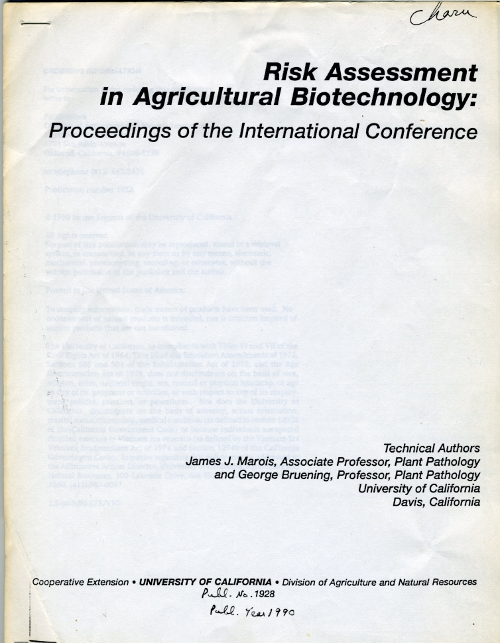
My yellowing copy of the proceedings from the 1988, Davis conference 

A similar conversation example occurred in 1988.  An International Conference "Risk Assessment in Agricultural Biotechnology” was held on the campus of the University of California, Davis.  This was one of many, fully public and fully voluntary discussions of the specific safety issues for what would later be called “GMO crops.”  What was extraordinary about this and other conversations was that it was not just an exchange of information and a mechanism to sort out conflicting information or perspectives.  It was part of a voluntary,  multi-agency, regulatory review process, which had already been put in place even though it would still be several more years until any biotech crops were commercialized.  The conversation has continued with the publication of hundreds of safety studies - a great many of which are independently funded. (See the GENERA database)

This is not the normal path for the development of technology regulation.  Usually there is some unintended and unanticipated problem that arises with a new technology, and a regulatory regime needs to be created to address it.  In the case of “GMO crops,” the regulatory process was set up in advance, and is likely part of the reason for the safe track record as this technology has been deployed on hundreds of millions of hectares around the world over the last 20 years.   This has been, and continues to be an excellent example of "science as a verb."

As scientists, we sometimes misrepresent our craft by saying things like “the science says,” or “the science is settled.” In so doing we are treating science like a noun.  We do that out of frustration with a phenomenon like parallel science and the unnecessary fear and superstition that it has engendered about “GMOs.”  When that happens we should hum the melody from Mayer’s classic song and think the lyric, “science ain't a thing, science is a verb."

You are welcome to comment here and/or to email me at savage.sd@gmail.com

reade more... Résuméabuiyad

Pesticides: Probably Less Scary Than You Imagine


 The word "pesticide" conjures up negative, scary images. These images come from old organophosphate insecticides of the 1960s that killed fish and birds and caused farm worker illness.  These are sorely outdated images. What most people don't know is how much safer the new generations of pesticides are.  In fact, scores of old materials have been withdrawn from the market or banned long ago.  The new products are mostly compounds with extremely low mammalian toxicity and benign environmental profiles.  Today's pesticides are not your grandfather's or even your father's pesticides. Fortunately, you don't have to take my word for this.  There are some excellent sources of public data on this topic. These  products emerged from an on-going chemical discovery effort involving billions of dollars of investment over decades.  


Pesticides From A Consumer Perspective


One source of information about pesticides is a huge, annual sampling and testing exercise that the USDA carries out to look at what pesticide residues can be found in the food supply.  I have previously posted an analysis of that that data set from 2010 (latest available).  It shows that the residues that can be detected on US foods are at such low levels relative to conservative tolerances, there is no reason for US consumers to worry about them.  


What Sort of Pesticides Are Farmers Using Today?


When a recent, Stanford, meta-study cast doubt on the nutritional advantage of organic foods, some consumers stated that it is still worth it to buy organic because it doesn't have pesticides.   Many, perhaps most, consumers believe that organic means "no pesticides." This is simply not true - though it is a convenient fiction for some marketers and advocates. There are many pesticides that are allowed to be used on organic crops.   

One of the best ways to look at what is being used in both conventional and organic farming is to look at the extensive and transparent, California Pesticide Information Portal (CalPip).  California has a tremendous diversity of crops and also a very large share of the organic market.  It is a source for data which comes from mandatory reporting of all commercial pesticide use in the state.  CalPip posted two lists of the top 100 pesticides used - one based on total pounds applied and one based on the total number of acres treated.  I created a list that combined the two without the surfactants or other spray additives.  That left 104 materials.  I then looked up the publicly available, MSDS documents (Material Safety Data Sheets) to get the acute toxicity (oral ALD50) for each of the products (see graph below).  


The EPA defines a range of toxicity categories from I to IV, with IV being the least toxic (essentially non-toxic to mammals, but their terminology is classic regulatory-cautious).  On a weight basis, the largest share of pesticides used in California in 2010 fall into the least toxic category (62%).  The blue part of the bar includes products which allowed for both organic and conventional farms.  
About 1/3 of all the pesticides used in California in 2010 fall into the "slightly toxic" or "moderately toxic" categories.  Note that there are organic products in these toxicity categories as well.  Most of the organic pesticides in categories II and II are copper salts (copper sulfate, copper hydroxide...).  These are old products which the EPA still allows with some restrictions because of copper's issues with toxicity to aquatic invertebrates and environmental persistence.  Conventional growers can control the same plant diseases that organic growers treat with coppers using various category IV products which are less toxic which have benign environmental profiles.   Why would organic growers use pesticides with somewhat more risk issues than conventional?  Because the criterion for organic approval has nothing to do with safety as such.  It is all about whether it meets a certain definition of "natural."   As we will see later, categories II an III are not all that scary, but it is worth noting that organic does not automatically mean better from a pesticide perspective.
Note that only 0.2% of the commonly used chemicals in California fall into the "Highly Toxic" category, and those are used under strict limits to prevent any form of unwanted exposure.  Just for interest sake, however, Vitamin D3 would fall into this category if it were a pesticide.

How Toxic Are These Different Categories?

It is not that easy for most people to relate to these EPA category descriptions, so it is useful to make comparisons between pesticides and familiar chemicals in foods and pharmaceuticals (see graph below).

Vitamin C is something which many people take in large, 250-1000 mg doses on a regular basis.  Fifty-five percent (55%) of the pesticides used in California in 2010 were less toxic than Vitamin C. Sixty-four percents (64%) were less toxic than vitamin A.  Seventy-one percent (71%) were less toxic than the vanillin in ice cream or lattes. Seventy-six percent (76%) of the pesticides were less toxic than prozac and 89% were less toxic than the ibuprofen in products like Advil.  Ninety-seven percent (97%) of California pesticide use in 2010 was with products that are less toxic than the caffeine in our daily coffee, the aspirin many take regularly, or the capsaicin in hot sauces or curries.  This is not the sort of image that most people visualize when they hear the word "pesticides."

Of course, acute oral toxicity is only one of many dimensions of the EPA risk assessment that is behind all product registrations and reviews.  That is why, from a consumer health point of view, the comparison of residue levels to a tolerance is the most appropriate statistic by which to judge consumer safety (it factors in various forms of chronic exposure and the nature of the crop itself..).   People are also concerned about combinations of chemicals, but our diets contain more complex combinations of natural plant-made chemicals at much higher concentrations.   The beneficial aspects of eating things like fresh produce far outweigh any concerns about the pesticide residues that are in either organic or conventional foods.

What About Farm Workers or the Environment?


The people who tend our crops are certainly exposed to pesticides far more than any consumer.  What about them?  If one looks at the data for exposure via skin or breathing, a similar pattern emerges to that for oral toxicity - modern chemistries are low in hazard and thus in risk.  There are also label restrictions that prevent workers from being exposed to the more hazardous materials (e.g. what protective clothing is required and how long after a spray before anyone can re-enter the field).  All the registered pesticides are also extensively studied in terms of their effects on "non-target" organisms and their environmental fate.  The rules for how any given pesticide can be used (the label requirements) factor in worker and environmental risk.  Once again, the sort of issues that were common in the 1960s are not at all reflective of the modern situation.  Some organically approved pesticides have their own worker and environmental issues which are also mitigated by the same sorts of EPA label restrictions.

Are Pesticides Really Needed Anyway?

Yes, they certainly are.  Farmers use many other methods than pesticides to control pests (I'll be writing about that soon), but without pesticides our farms would be far less efficient in terms of resource-use-efficiency (land, water, fuel, fertilizers, labor).  That is why both organic and conventional farmers often need to use pesticides.  Again, the organic pesticide list was not created based on its risk profile, so there are many cases where the conventional options are as low or lower in risk than the organic option.  

So, overall, the “its all about pesticides” argument for buying organic is not compelling in a modern time-frame.  If someone wants to spend the extra money for organic, that is their choice. Someone who does not want to by organic should feel neither guilt nor fear about that decision.  It is a choice that is well supported by the science.


Spraying image from the USDA-ARS.  Graphs by Steve Savage based on CalPip Data.  I'm also happy to share my data files with those that are interested.  You are welcome to comment here and/or to write me at savage.sd@gmail.comhttp://appliedmythology.blogspot.com/2012/09/pesticides-probably-less-scary-than-you.html
reade more... Résuméabuiyad

Major Scientific Conference Convened to Review The Safety of GMO Crops

(This post originally appeared on Biofortified on 1/25/12)
A major international conference scientific meeting titled "Risk Assessment in Agricultural Biotechnology" was held at the University of California, Davis.  It was sponsored by the College of Agriculture, The National Association of State Universities and Land Grant Colleges, and the USDA.  It included presentations by eminent scientists from around the world and covered a wide range of topics including potential effects on non-target organisms, potential health effects, ecological risks, and the potential for "gene flow" for various crops.  There was extensive discussion of how to best regulate this technology, and what monitoring methods were appropriate.  There was also a discussion of potential impacts on community function in agricultural areas.  Finally there was an analysis of how risk assessment affects public perceptions of biotechnology. If you are reading this now, chances are you just missed it - by more than two decades!
I was fortunate to be able to attend this event and was reminded of it the other day when I found a copy of the proceedings while clearing out some old paper files (remember those?, see yellowed document below).

This conference was held in August of 1988 - nearly twenty four years ago!   The meeting was held was eight years before any "biotech traits" were commercialized in Agriculture.  Even at that time, these topics had already been under consideration for a long time.  I first became aware of these discussions at Stanford in 1977 - 35 years ago.

This Does Not Fit With Widespread, False Narratives About This Technology

The reason a bring up this meeting is that I often hear or read assertions that plant biotechnology was something that was abruptly introduced without precautionary review.  Nothing could be further from the truth.  I'd be surprised if there has ever been a technology that received this much scrutiny from a broad range of independent experts (most of the people at the 1988 event were from academia, not industry).  Some say there is insufficient regulation of the technology, but in fact regulators at the USDA, EPA and FDA spent years figuring out what aspects of the technology each would regulate. That was a major topic of discussion at the 1988 meeting, and there were many other opportunities for public input.

Roads Not Taken

Looking back at the program from the 1988 meeting I was reminded that this risk assessment process was far from a rubber stamp.  There were several ideas that were never pursued commercially because the risks were deemed to be too significant.  For instance, it was decided that genetically engineered microbes should not be introduced live into the environment.  It was decided that GMO crops should not be introduced into areas where there have weedy relatives (e.g. sunflowers in the Midwestern US). There was the idea of improving the amino acid balance of corn (which is low in lysine) by incorporating the gene for the lysine-rich seed storage protein from Brazil nut.  Once the gene for the protein was isolated and expressed in a lab microbe, it was possible to test to see if that was the reason some people are allergic to Brazil nuts.  It turned out that it was the allergen, so the project was discontinued at that very early stage.  Some of the early examples of plant genetic engineering were done using something called the "gene gun."  That method often lead to insertions of multiple copies of the gene and so virtually all the work shifted over to the Agrobacterium vector approach - an organism from nature that is good at inserting single copies of genes into plant cells.
Sixteen years and billions of acres into the biotech crop revolution, it seems that the prior years of risk assessment have paid off.

You are welcome to comment here and/or email me at savage.sd@gmail.com
reade more... Résuméabuiyad