Pages

.

Showing posts with label USDA. Show all posts

Organic Might Not Mean What You Think It Means

(This post originally appeared on Forbes 3/6/17)

Organic might not mean what you think it means.  Recent data generated as part of the USDA’s Pesticide Data Program (PDP) shows that there are detectable, low level pesticide residues on organic fruits and vegetables. This isn't surprising information.  It echoes results from previous PDP testing and with more comprehensive testing of organic samples in 2001-11 by the USDA and 2011-13 by the Canadian Food Inspection Agency. What is interesting is that while the incidence of residue detection is somewhat lower for organic, the very low levels of chemicals found are quite similar to the low levels detected on conventional samples. The 2015 PDP study found residues of 68 different pesticides, pesticide metabolites, or plant growth regulators on organic fruits and vegetables.


Red organophosphates, Blue carbamates, Green organochlorines from historical use


For 37% of these chemicals the average residue on organic samples was actually higher than the averages on conventional, but still very small.
What really matters is that the levels detected for both kinds of produce are below the “tolerances” that are set by the EPA and those tolerances already reflect a generous safety margin.  

So, what these data really tell us is this:
“Yes. Skilled analytical chemists can detect tiny amounts of synthetic and natural pesticide residues on organic and conventional produce. In both cases the level that are found are below to well below any threshold of concern. Our regulatory system is working. Those who grow our food are well trained and are following the rules designed to both enable crop production and protect the public. Enjoy your safe, healthy, delicious options!”

Background on the PDP


Each year the USDA gathers and analyzes around ten thousand samples from the mainstream US food supply – mainly fruits and vegetables. In the sampling process, USDA ends up including some items labeled as USDA Organic (349 samples in 2015, 4% of the total). USDA labs then look at all the samples for residues of crop protection chemicals using extremely sensitive analytical methods.

USDA provides both brief and detailed summaries of this information, but I appreciate the fact that the raw data is transparently available to the public so that I can look through it myself (it is bit challenging because there is a two million+ row main table, a 10 thousand row sample table, and 18 reference tables). I looked in detail at all the pesticide detections and also looked at the testing results for produce samples that were being sold with the organic claim.

What Was Found?


As with the overwhelming majority of samples, the residues detected on the organic items are at levels below the conservative “tolerances” that are set by the EPA. Yes, residues are present. No, they are not a safety problem. However, the presence of residues does conflict with what many consumers have been led to believe about the difference between organic and conventional.

Many people think that organic means “no pesticides.” That is simply not true. Organic farmers can and do use a range of allowed pesticides because they too have to deal with pests. The list of organic-approved pesticides is not based on safety criteria but rather on whether or not they can be considered “natural.” Again, in spite of much misleading marketing, “natural” does not automatically mean safe. In fact the USDA which is in charge of organic certification specifically states on its website that “our regulations do not address food safety or nutrition.”

As with all pesticides and other crop protection products, it is the EPA which assesses which pesticides can be used safely, and within what constraints.

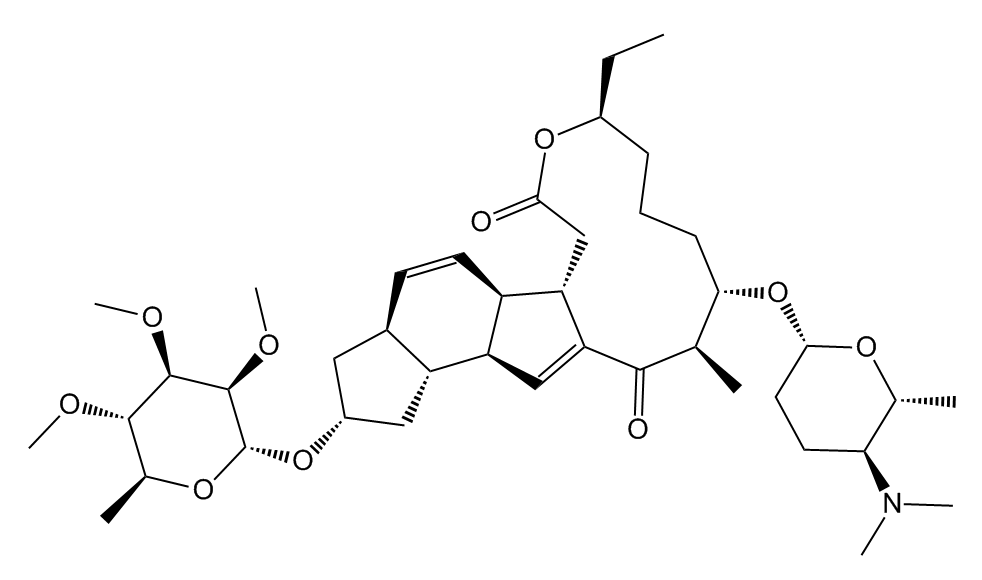
So what sorts of residues are found on the organic samples? The most common detection is of an insecticide called spinosad. That is an effective control for a variety of caterpillar pests and is produced through a microbial fermentation process, thus allowing it to qualify for use in organic (see chemical structure of one of the spinosyns below). Just to be clear, the spinosad products are produced by the Dow chemical company.

Chemical structure of a spinosan (Image from Cappacio)
Conventional farmers also make good use of this and other natural products. Spinosad is really the only natural product pesticide that is detected in the USDA’s monitoring program. Other widely used products like sulfur, petroleum distillates, copper salts and microbial products can’t be monitored using the same, highly sensitive and cost-effective tools that allow the USDA to generate the more than two million test results they generate each year. If specific tests were conducted for those natural products, the number of residues detected per organic sample would probably be much larger – but it wouldn’t really change the overall conclusion that these foods are safe to enjoy.


Other than spinosad, the remaining 80.2% of residues detected on organic are of “synthetic” chemicals.

Graph by author

While very few of the synthetic materials used in agriculture today are intrinsically very toxic to humans, they are theoretically not supposed to be present on organic because they are not on the list of approved, natural options.

There is however a rule in the organic certification system that any residue present at 5% or less of the USDA tolerance will be considered “unintentional” and thus not a reason to deny organic certification. 62.1% of the 2015 organic detections met that criterion, but interestingly so do 74.6% of the detections on non-organic samples from the US and 70.1% of the detections from imported, non-organic samples. Not so different.

Another 15.6% of residues detected on organic technically violate the organic rules by being over 5% of EPA tolerance, but such residues are still fully safe based on EPA criteria. That same safety criterion applied to 23.0% and 25.2% of conventional US and imported samples respectively. For both organic and conventional there are a few detected residues of products that don’t have a specific, assigned tolerance for the crop in question. These are generally very low-level detections, so while they represent technical violations they are not of real concern and once again, similar for organic and conventional (average “no tolerance” detection for organic 23.7 parts/billion, average for conventional imports 19.8 ppb, and average for US conventional 17.2 ppb).

To reiterate, what this transparent public database tells us is that our food supply is safe from the perspective of pesticide residues. This means that our regulatory system is working and that thousands of farmers in the US and elsewhere are doing a great job of managing pest damage while still protecting our health. The data also tells us that there are some striking similarities between organic and conventional when it comes to residues. What the data also tells us is that as consumers we should reject some of the misleading marketing and advocacy efforts of certain irresponsible elements of the organic industry. Instead of giving in to those fear-based campaigns we should feel the freedom to choose healthy and delicious produce using important criteria like freshness, flavor, quality and affordability.

There is a site you can use to visualize the PDP data http://www.cropaudit.org/

You are welcome to comment here and/or to email me at savage.sd@gmail.com


reade more... Résuméabuiyad

Another Biotech Apple That Can Help Change The Conversation About "GMO Crops"

A picture of the Arctic Granny that appeared in a great article in the trade magazine, Growing Produce last year.


Non-browning apples and potatoes are part of a second wave of biotech crop improvements which I believe will change the public conversation about "GMO crops" in a positive way.  A third Arctic Apple cultivar (Fuji) is currently going through the USDA deregulation step which will open the way for commercial production over the next few years.  Apparently the public comments to USDA have been overwhelmingly positive.  I decided to add my own comment because I've had the opportunity to meet the great folks at Okanagan Specialty Fruits who developed these apples, and the folks at Intrexon who are supporting the commercial phase.  I am very impressed with what they have accomplished and the plans they have for bringing these great products to consumers.

I've copied below the text of the comment I submitted to USDA today.  If you would like to comment you can do so at this link:

https://www.regulations.gov/comment?D=APHIS-2016-0043-0001


My Comment to USDA About The Arctic Fuji, Non-Browning Apple


"I am writing in full support of this particular deregulation of the Arctic Fuji apple.  I do this as an agricultural scientist, as a long-term observer of crop biotechnology (40 years), as a consumer, and as a grandfather.  USDA-APHIS is completely justified in concluding that this RNAi-based, non-browning trait represents no "plant pest issues" so that commercial planting can proceed.  The "genetic contamination" issue that is sometimes raised is meaningless for a crop like apples that is never grown from seed but which is vegetatively propagated and which is commonly pollinated with crab apple.  Pollen movement presents no problems for apple growers or for consumers.  As a plant pathologist I concur with the conclusion from field tests which indicate that the trait has no effect, positive or negative, on the pest resistance profile of apples.

What this trait does provide is a combination of food waste reduction and opportunities for desirable consumer options such as full flavor and aroma sliced apples, no-sulfite dried apples and, use in smoothies etc.  I've tasted examples of all these uses with previous cultivars and can highly recommend them to my fellow consumers.

I have had the opportunity to share a box of a previously deregulated cultivar, Golden Delicious, with friends at a pot luck dinner last November.  I offered slices that had been prepared 4 hours before the event and showed how they were still white and aromatic while the conventional slices were browned to the point that no one wanted to take more than one comparison taste.  The non-browning Arctic apples truly "changed the conversation about GMOs" because it was a concrete example of how biotechnology can provide a meaningful consumer trait.  As Fuji is my favorite apple variety I am particularly enthused about being able to buy and share this next cultivar when the production is ramped up.  As many children do, my grand daughter loves apples, and I see this product as a way to further encourage that healthy inclination.

I fully realize that some of our international trading partners have irrational and problematic attitudes about biotech crops, but with a fully "identity preserved" crop like apples, there should not be a risk to our export business.  I am confident in the plan that OSF and Intrexon have for stewarding the main sliced product line and the co-product lines.  I believe that a timely deregulation of this and subsequent cultivars will send the appropriate message to the global market for apples.

Finally, I believe that this trait demonstrates that even a small commercial entity can navigate both the technological and regulatory path to biotech product development.  The vast majority of the work even with this cultivar was done by a company with around 8 employees!  While our system would benefit by some stream-lining and greater emphasis on product over process, this remains an important precedent.

So again, I want to express my whole-hearted support for this deregulation decision.

Steve Savage, Ph.D."

My grand daughter holding a Fuji apple she picked in
my yard a couple of years ago (unfortunately the browning kind)
You are welcome to comment here and/or to email me at savage.sd@gmail.com
reade more... Résuméabuiyad

Inconvenient Truth: There Are Pesticide Residues On Organic


(Originally posted on Forbes 2/8/16)

A recent review article in the scientific journal Nature Plants makes the claim that organic produces "foods that contain less (or no) pesticide residues, compared with conventional farming."  That's not what the latest USDA-PDP (Pesticide Data Program) information about pesticide residues says. What that transparent source of tax payer-supported research indicates is that 40 different synthetic pesticide residues were detected on organic food samples at levels similar to what was seen for the comparable conventional food samples. In both cases the amounts are too small to be a health/safety concern, but this certainly does not fit the standard organic narrative.
Commodity breakdown of the food samples used
for pesticide residue testing in 2014
For the 2014 survey, USDA scientists collected just over 10,000 samples of 15 crops taken from ordinary retail food channels.  The scientists then used extremely sensitive laboratory methods to check for traces of hundreds of different chemicals.  409 of the samples were labeled as organic, and residues were detected in 87 of them.  Thus 21% of the organic samples had detectable residues representing 142 detections in 78 crop/chemical combinations.  That detection percent is lower than for conventional, but the PDP testing does not have the capacity to detect several of the most commonly used, organic-approved pesticides like sulfur, copper compounds, mineral oils or Bt.  Those materials can't be measured with the same technology used for the other chemicals, so the USDA has chosen not to test for them. If they did, the detection percentage for organic would be much higher.  One organic-approved pesticide that is measured by the USDA is called Spinosad, and it was detected on 13 organic crops as expected.  However, the other 40 of the 41 different pesticides detected on the organic foods were synthetic chemicals that are not approved for use on organic.

Finding synthetic pesticide residues on organic is not unprecedented.  Earlier, larger surveys of organic conducted by the USDA and by Canadian Food Inspection Agency found un-approved residues in at least 40% of samples.  The normal explanation of this is that it represents inadvertent spray drift or cross-contamination in harvesting bins etc.  Many of the detections are at such low levels they fit those scenarios, but interestingly when I looked at the conventional detections for the same 78 chemical/crop combinations, the organic detections were only significantly lower in 26 cases, and the organic detections were equal to or higher than those in conventional for 30 cases (see chart below).

Note how for many chemical/crop combinations the level
detected in organic was similar to or greater than
that in conventional samples

For organic advocates and organic marketers this sort of information leaves one of two possibilities.  They can agree with the EPA and other responsible agencies that consumers need not be concerned about the low-level pesticide residues found in either conventional and organic food.  Alternatively they could choose not to believe those authorities and be forced to conclude that organic food is unsafe.  For consumers the logical take-home message is that between our rigorous regulatory regime and our responsible farming communities, we can enjoy a safe, healthy diet full of fruits and vegetables without having to believe that safety is only available at a price premium.
There are several ways that you can review this information for yourself.  The USDA published a "what consumers need to know" document, a fact sheet, and a 230 page summary.  They also make the raw data available for download (as long as you are up for processing a 2.2 million row, 98MB table).  I like to take advantage of all that detailed, transparent data, and I will be publishing a more complete, independent analysis soon.
Twenty-three percent of the detections in organic were of old organochlorine or organophosphate insecticides or their metabolites (e.g. DDT, monocrotophos...). These are persistent environmental contaminants (they have been banned for decades). These chemicals are found in both organic and conventional samples at levels in the low part per billion range. This is an unfortunate artifact of pre-EPA history, but fortunately not a current health threat.  Three point five percent of the organic detections were for currently-used carbamate and organophosphate insecticides (Oxamyl, Carbaryl and Chlorpyrifos and Dimethoate), but all at levels well below current safety tolerances.  Seven point seven percent of detections were of neonicitinoid insecticides, and 9% were synthetic pyrethroids.  Other insecticides made up 3.5% of the detections.  Fifteen different fungicides represent 25% of the detections. There were detections of two different herbicides, 2 of a miticide and 3 of an insecticide synergist. Again, these detections are, for both organic and conventional, at levels too low to be of concern.  Indeed, what the the data demonstrates is how far below.
The reason that the USDA has been conducting its Pesticide Detection Program since 1991 is to monitor how well the system is working to insure that farmers can control damaging pests and still supply food that is safe for consumers.  What the data has consistently shown is that these goals are being met and that consumers can confidently enjoy a healthy diet rich in fruits and vegetables.
However, an organization called the Environmental Working Group has severely mis-used these data year after year to construct what they call their "dirty dozen list."  They are funded by many of the big players in the organic market (Organic Valley, Stonyfield Farms, Earthbound Farms, Applegate, Klean Kanteen, Dr. Bronner Soaps, Beauty Counter, Juice Beauty, Brown Advisory, Nature’s Path, Annie’s), and their goal is to frighten consumers away from conventional food and towards organic. The problem is that their non-scientific approach of simply counting detections regardless of the level or identity of the chemical would classify organic as "dirty" as well.  Consumers should simply ignore the disinformation that comes from EWG and consider not supporting the companies that fund them.

You are welcome to comment here and/or to email me at savage.sd@gmail.com


reade more... Résuméabuiyad

Why Is The USDA Getting Involved In A 15th Method Of Food Labeling?


(This post originally appeared on Forbes, 5/28/15)
A couple of weeks ago I was deeply disappointed to read that the USDA might get involved in an aspect of “non-GMO food labeling.”  The marketing of non-GMO food is an opportunistic, fear-based phenomenon – not something worthy of aid from a science-oriented agency like USDA.  Also, if the goal is to allow consumers “know more about their food,” then why not transmit knowledge with context and perspective that would diminish, rather than promote, superstition? Printing was state-of-the-art in 1435.  We can do better in the 21st century!

Superstition?

It may seem extreme for me to declare that the fear of GMO foods is a superstition, but consider the history of this phenomenon.  For two decades, the opponents of crop genetic engineering have promoted the idea that transgenics, a particular means of genetic modification, is something sinister and frightening.  Their arguments are typically accompanied by emotive images such as hypodermic needles full of colored liquids protruding from ripe fruits and vegetables.  Such images bear absolutely no connection to the actual process of plant genetic engineering.
Examples of what crops looked like before humans began the process of genetically modifying them
(From Genetic Literacy Project)


These websites don’t communicate the fact that virtually all crops have been “genetically modified” in many ways for centuries and that transgenics have been the most carefully introduced and independently tested of all.
Although all of the major scientific bodies around the world have affirmed the safety of “GMO crops,” the fear-based messaging has worked. This has created an up-selling opportunity in the food industry, and that kind of marketing is well served by the two word message, “non-GMO.”  The seller can tap in on all the emotive, doubt-sowing efforts to date without any potential confusion that would be created by knowing the full story.  It’s effectively a “right to not know.”

Wikipedia example of a scan code
In an era of scan codes and smart devices, a curious consumer could have all the resources they need in an interactive, multi-media form.  They could ask: “What are the ingredients in this food?”  “Where has it been sourced and why?”  “What is known about the safety of the ingredients and the food as a whole?”  “What does the nutrition labeling information on the back mean?”  “What kind of farms and farmers were involved in the production of this food?”  “Why do farmers choose to use certain agricultural technologies?”  Consumers could “know” a great deal.


A Suggested Role For USDA

The drawback with this is that as with all information available today, it is very hard for the consumer to sort out what is true.  Here is where a public agency with extensive expertise in the practice and science of agriculture could play an appropriate role.  They could be an independent “third party” that could vet the information offered via 21st century methods.  To do so would require more resources for the USDA because their workers are already engaged in other important work.  As consumers, we would be better served by a modest increase in USDA funding via our taxes than by spending billions on “GMO-free” food marketed based on superstition. If you have not heard it in a while listen to Stevie Wonder’s classic song, “Superstition” , particularly the repeated lyric:
“When you believe in things that you don’t understand, then you suffer... superstition ain’t the way.”
Now imagine the lyric,

"When you're afraid of things you don't understand, and you pay more... superstition ain't the way."
Wikipedia image of Stevie Wonder from 1973 - Lyric slightly modified

You are welcome to comment here and/or to email me at savage.sd@gmail.com

reade more... Résuméabuiyad

My Comments To The USDA On Agricultural Coexistence


Today I submitted a comment on the official USDA regulatory forum on the question of coexistence in agriculture.  Here is a link for background from a workshop on this topic held in North Carolina this March.  Here is a link of you want to comment (>4500 people have so far and the comment period is open until May 11, 2015).

The point I hoped to make was that coexistence between different kinds of farming is something people have known how to do for a very long time, but it requires a certain level of reasonableness and cooperative spirit.  That is rarely a problem when you are talking about real farmers and if there are rational standards for "adventitious presence."  The issues to do with coexistence today arise from downstream players making unreasonable demands and by those which are not, by their own statements, interested in coexistence.  The USDA seems to be trying hard to make this an open dialog, but there are aspects of this debate that need to be recognized for what they are.

Text Of The Comment I Submitted 4/28/15


While the coexistence of diverse commodity and identity preserved crops is a long-standing, successful feature of American agriculture, some aspects of the current coexistence discussion warrant careful consideration.  Particularly for row crops, the definition of acceptable “adventitious presence” is critical in any identity preservation effort.  That threshold drives the costs of isolation and segregation protocols as well as the level of risk for the producer.  The threshold of adventitious presence should logically be driven by objective issues of functionality in the intended use and/or by levels that are practical in the real world.  That sort of system has long enabled coexistence in farming.

The current problems for co-existence arise in what many participants in the North Carolina workshop described as "sensitive markets."  Principally this means products intended for "non-GMO" and/or organic markets.  Unfortunately, a significant proportion of those markets have been established at the consumer end through fear-based marketing and advocacy.  For these IP segments there is no "reasonable level of adventitious presence," because the categories were never based on any reason-based functionality or safety criterion.  Perhaps "fear-based marketing" sounds like a harsh term, but if you look at examples of promotional campaigns generated by very large, for-profit, organic and non-GMO food companies, it’s hard to come up with a friendlier sounding descriptor:

1. This recent video produced by Organic Only, a consortium of organic marketers including may of the largest ones:

2. Several productions from the large, non-GMO promoting fast food chain, Chipotle:

3. This humorous, but not fair 2005 production from the Organic Trade Association: 

Coexistence requires, by definition, some level of fair play and mutual respect from the parties involved.  The corn and soybean growing neighbors who are trying to make a living in commodity and IP markets may have that sort of working relationship, but the demands coming down to them from "sensitive markets" are often driven by rather successful, fear-for-profit business models.   These downstream drivers are certainly not on the "coexistence" page at all – in fact exactly the opposite.  Some explicitly state that their goal is the elimination of biotech crops via the agency of GMO or non-GMO labeling and its effects on markets.  As is usually the case, the farmers have virtually no leverage in these exchanges.  With this enormous gulf in terms of power and intention, the prospects for rational co-existence are not encouraging.


There are certainly players in the organic and gmo-free segments that could be reasonable participants in a coexistence discussion, but their voices do not represent or apparently influence other important players.  It would be irresponsible to fail to explicitly acknowledge this “elephant in the room.”
reade more... Résuméabuiyad

Why Organic Can't Fulfill Our Food Supply Ideals


Almost any farmer or consumer could agree on the following ideals for our agricultural system:

"Farming in ways that are best for us, best for the environment, and best for providing an adequate food supply."

I believe that these are the goals and ideals of organic customers and organic farmers, and I share them. If organic could deliver on these “triple best” goals, I would be among its strongest supporters, but I don't believe that it can.  The organic rules are based on the assumption that “natural” is always best.  That assumption originated in a pre-scientific era, and it does not hold up to what we have learned over the last century.  The "natural" definition is great for marketing purposes, but often not the optimal criterion to guide farming practices. 

The Original Contribution of the Organic Movement


The important contribution of organic early in the last century was its focus on improving soil health/quality.  The pioneers of the organic movement worked out certain farming methods using “natural fertilizers” to mitigate the nutrient-depleting and soil-degrading effects of the plow-intensive farming of the late 19th and early 20th century.  The organic focus on natural also meant that it eschewed some of the early pesticides, which were later found to be problematic for health and the environment.  For a period of time, organic may have been, in fact, the best farming option for us and for the environment.

A pretty picture, but for soil erosion and soil health this
kind of farming was highly undesirable


Since then we have learned more and more about environmental systems, genetics, microbiology and human health.  Based on that, increasingly rigorous regulatory processes were put in place and farming practices have changed dramatically.  Sometimes organic growers were in the lead in making those changes.  But increasingly, the “natural” constraints of organic are making it difficult or even impossible for organic farmers to implement what we now know to be best for us, best for the environment, or best for the food supply.  I'd like to describe six specific examples of those limitations.

1. Nitrogen Fertilization


One of the greatest challenges of farming is providing a growing crop with the necessary mineral nutrients when it needs them. When nutrients are free in the soil and not being actively absorbed by the growing crop, they have the potential to move into ground water, or to wash off into surface water.  If they do, they can become health issues and/or foster algal blooms that cause “dead zones” in bodies of water.  Excess nitrogen in soils can lead to the generation of the potent greenhouse gas, nitrous oxide. There are specific conditions under which natural fertilizers like manures or compost can reduce these problems, but there are also conditions under which the uncontrolled, nutrient release pattern from natural fertilizers can be quite problematic. Depending on how and when they are delivered, “synthetic” fertilizers can be deployed in ways that do a better job of providing the crop’s need without as much risk of these forms of pollution. For example, drip irrigation systems are very efficient ways to deliver fertilizers but cannot be used for most forms of organic fertilizers. Triple-best farming requires the ability to use both natural and synthetic fertilizers in the right settings and with the right delivery methods. There is even the possibility of making synthetic nitrogen using renewable energy.  

2. Low Risk Pesticide Use

What makes a pesticide safe for us or for the environment is not related to whether it is “natural."  Some of the most toxic chemicals known are produced in nature. The reason that the American consumer can have confidence in the safety of crop pesticide use is that the EPA demands a great deal of data for its multi-dimensional risk assessment for any chemical, natural or not, that is going to be used for pest control.  These tests involve multiple dimensions of human toxicity as well as assessments of environmental fate and environmental impact. Some, but not all “natural products” meet those standards.  Some, but not all, synthetic products meet those standards.  The details of how synthetic or natural pesticides can be used are then dictated in “label requirements” specific to the properties of that chemical (e.g. how long before the crop is harvested, what worker protection standards are needed, what considerations are needed relative to sensitive environmental settings…).  It is this regulatory process, not naturalness, which ensures environmental safety and residue levels that are safe even by very conservative standards.  In many cases the "synthetic" options are the very best choice among the approved options. 
(Note: the graph of California use data shown earlier has been removed.  Sulfur classified in that figure as Category II is actually Category IV for oral acute toxicity, Category III for dermal toxicity)


3. Fully Integrated Pest Control

Baby Spinach Growing In Coastal California

Organic farmers have been early adopters of many pest control options other than classical, chemical pesticides (genetic resistance, biological controls, crop rotations, natural pest enemies, and pheromone-confusion…), but at least since the 1970s, this has also been a growing component in “conventional agriculture” called Integrated Pest Management(IPM).  In many crop systems, modern synthetic pesticides are one important component in these mixed approaches.  For example, there is a problem in the current, California spinach crop, which has around 50% organic production.  There is a disease of that crop called downy mildew and it is transmitted from season to season via survival in the seed.  Through conventional breeding, it has been possible to develop spinach that is resistant to that fungus.  The conventional growers also use a relatively benign synthetic fungicide as a seed treatment against the disease - thus they are using an integrated program of genetics and a fungicide.  For the organic production, the seed treatment is not allowed.  Without the multiple control strategy, the fungus has rapidly mutated to get around the genetic resistance, and six good sources of resistance have been lost within a few years.  Each time, the newly virulent strains have emerged first in the organic fields. This gap in the IPM program is now putting the entire California spinach industry at risk.  There are similarly precarious situations in other crops.

4. Biorationals

It takes a lot of money to do the testing needed to commercially develop and insure the safety of any new agricultural pesticide - more than $200MM.  That level of spending is appropriate to meet our modern safety standards, but it means that the commercial development of any new synthetic pesticide can only be justified for a very large market within the agricultural realm.  For problems that only affect a small part of the food supply, it is not possible to justify the investment in a new option.  Fortunately, the EPA has a special, lower cost registration process for low toxicity chemicals that already occur within the food supply. 


The sprouts of potatoes are actually rather toxic, so don't eat them


A good example of this is a new product for preventing sprouting in stored potatoes.  The compound 3-decen-2-one already occurs in at low levels in potatoes as well as in mushrooms, tuna fish, yogurt and soy.  An identical, synthetic version of the chemical can now be used with stored potatoes and it is a better, safer option than the old sprout inhibitor, CIPC.  Because of a purist interpretation of the organic rules, the new sprout inhibitor cannot be used for organic potatoes.  Instead they are treated repeatedly with clove oil – a more costly and less effective option with no other “triple best” advantages.


5. Soil Building

Starting in 1960, farmers have been working out farming systems that do not require physical tillage of the soil.  When these are combined with the use of cover crops and GPS guided equipment use, it is possible to raise the important row crops (wheat, barley, canola, soybeans, corn, cotton…) in no-till or minimum-tillage systems that improve soil health and quality.  It is also an important “best” system to prevent soil erosion, reduce water pollution risk, and sequester carbon to mitigate climate risk. 

No-till Soybeans Following Corn


This system is much more like the way soils are built in natural prairie habitats and is not dependent on outside inputs of organic matter as is the case in the typical organic systems.  In order for these new options to be pursued efficiently on a large scale, herbicides are necessary as are controls for certain pests which are favored in a non-tillage system.  Organic growers don’t have many of the practical tools to manage these issues, and so they are ironically unable to fully or cost-effectively pursue these best, reduced tillage protocols.

6. Genetic Improvements

Genetic modification of crop plants has always been an important means of making farming better able to meet our food supply goals.  In recent history it has become possible to make more precise genetic modifications using the tools of genetic engineering – tools which were in fact drawn from nature. For example,  restriction endonuclease enzymes occur naturally and cut DNA at specific target sites, and the Ti plasmid of Agrobacterium which inserts DNA into chromosomes of plants.  In the last few years, even more precise and efficient tools for genetic modification have been discovered within a group of ancient microbes we call the Archaea (e.g. the CRISPR-Cas9system). 

Diagram of the CRISPR system via Wikipedia


As deployed within the unprecedented and rigorous regulatory framework for "GMO Crops", these tools have become an important means through which triple-best crop improvements can be made.  In her book “Tomorrow’s Table,” UC Davis molecular biologist Pamela Ronald has made an articulate argument for why these tools should be embraced for organic farming. But such suggestions are not even considered by the fierce defenders of the organic rules.  Even when genetic engineering is used to transfer something like a gene from wild potatoes into commercially relevant potatoes, the resulting triple-best crop will not be available to organic farmers (as in the case of the new, Innate 2 potato from Simplot)
European experiment showing healthy potatoes on the left that have the wild potato gene vs susceptible potatoes on the right without that gene


 A Missed Opportunity to Embrace Best Practices by Organic


There was a window of opportunity in 1990 when the organic rules could have been updated to use science-based criteria rather than the restrictive obligation of natural.  In that year, the US Congress tasked the USDA with formulating a national organic standard, and that research-oriented agency was inclined to bring modern knowledge into their rule-making process.  Such an approach was vigorously opposed by key elements of the existing organic advocacy community.  When the national standard emerged in final form in 2000,  at had only enshrined the "natural requirement" which continues to limit the ability of farmers to pursue many triple-best strategies such as those I’ve described above. 

Unfortunately, some of those who market organic products, and some who advocate for organic, continue to make unsupportable claims that organic is best for us and for the environment.  Many consumers accept these claims and believe that they are doing the right thing by paying the premium prices for organic items.  If we really had a food supply that was only safe and responsible for those able and willing to pay higher prices, that would represent a huge failing of public policy.  Fortunately, that is not the case.  Consumers and farmers with high ideals for the food supply can support farming in the ever-innovative mainstream system as it continues to find ways to farm that are best for us, best for the environment.

You are welcome to comment here and/or to write me at savage.sd@gmail.com


reade more... Résuméabuiyad